Omnisend alternatives for stores that send email and SMS
Omnisend's $11.20 headline is a three-months-upfront display; the monthly rate works out to $16. Eight alternatives priced at 500 to 5,000 contacts.
Short answer
Most people who leave Omnisend are small stores that outgrew the Standard plan's 500 contacts and 6,000 emails, or that found the monthly bill higher than the number on the slider. My pick for them is Drip: its first tier covers 1 to 2,500 people at $39 a month with unlimited email sends, which is $20 a month ($240 a year) under the $59 I derived for Omnisend's Pro plan, the one that lists a 2,500-contact allowance (Pro was read at Omnisend's 251 to 500 list-size selector, not at a 2,500-contact list). Choose MailerLite if you only send campaigns and want to pay $12 at 500 subscribers, and Klaviyo if you want the store-data ladder, at $60 for 2,500 profiles. Every price below was read on 7 October 2026.
Why people leave Omnisend
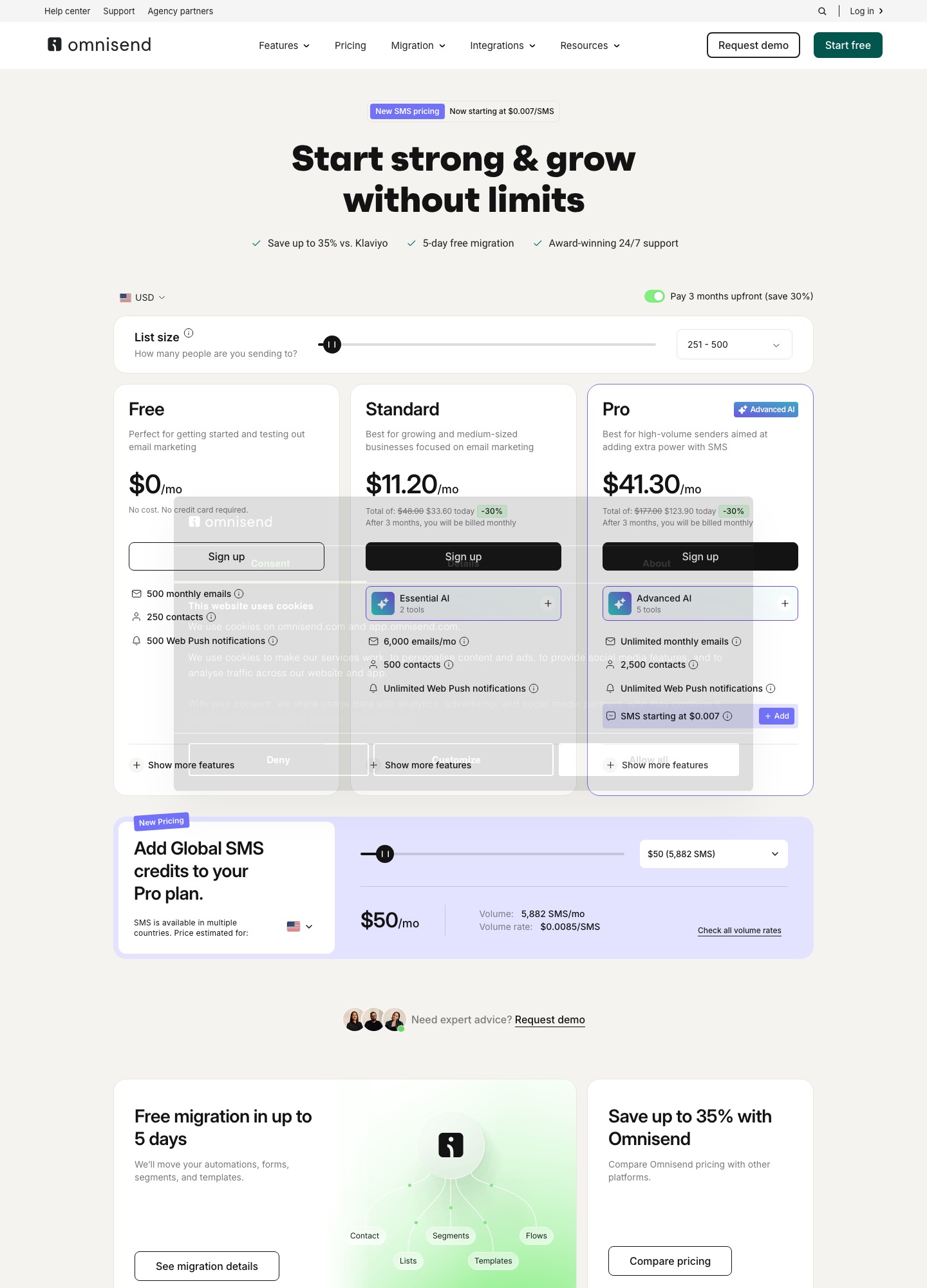
Omnisend's pricing page opens with a toggle, "Pay 3 months upfront (save 30%)", and it was switched on when I captured the page. With it on, Standard reads $11.20 a month and Pro reads $41.30. The small print under each card gives the real transaction: Standard is "$48.00" with a 30% discount to $33.60 today, and Pro is "$177.00" with a discount to $123.90 today, and both cards say that after three months you are billed monthly. Those two displayed prices are therefore a three-month prepayment spread over three months, not a monthly rate you can sign up for. Undiscounted, the arithmetic is $48 / 3 = $16 a month for Standard and $177 / 3 = $59 a month for Pro, or 12 x $16 = $192 and 12 x $59 = $708 over a year.
Four other things push people toward the exit.
- The free plan is small. Free is 250 contacts, 500 emails and 500 web push notifications a month. With 250 contacts, 500 emails is two sends per person per month, so a store that mails weekly is on a paid plan from its first campaign.
- Standard has a hard ceiling. It lists 500 contacts and 6,000 emails a month, which is 12 emails per contact. Pro lists 2,500 contacts and unlimited monthly emails, so the step between the plans is also a step from one contact limit to another. The card prices I read were both with the list-size selector at 251 to 500, so Pro's higher contact allowance is part of what its price buys.
- The billing unit is wider than subscribers. The page says you are billed for subscribers and non-subscribers who received automated messages, and that unsubscribed contacts are not billed. A store that sends automated order messages to customers who never opted in to marketing still counts them.
- SMS is priced by country and volume. The page advertises SMS "starting at $0.007" per message, and its calculator for adding SMS credits to Pro showed $50 a month for 5,882 SMS at a volume rate of $0.0085, with the United States selected. Only Pro lists an SMS add-on; the Standard card does not.
I read Omnisend's prices at one selector position, 251 to 500, where Standard includes 500 contacts and Pro includes 2,500. Omnisend's slider has more bands than that, and I did not read them, nor Pro at a 2,500-contact list, so where a comparison below sets Pro against another tool at 2,500 contacts, it uses Pro's allowance, not a price read at that list size.
Quick comparison
| Alternative | Best if you | Billing unit | Price at two sizes | Free plan |
|---|---|---|---|---|
| Drip | run a store and are past 500 contacts | People on the list | $39 at 500 and 2,500; $89 at 5,000 | 14-day trial, no free plan |
| Klaviyo | want order and product data in segments | Active profiles | $20 at 500; $60 at 2,500 | 250 profiles, 500 sends |
| Mailchimp | already have its integrations in your stack | Contacts | Standard $20 at 500; $100 for 2,501 to 5,000 | 250 contacts, 500 sends |
| MailerLite | mostly send campaigns | Subscribers | Comfort $12 at 500; $49 at 5,000 | 250 subscribers, 2,500 emails |
| Brevo | want to pay by email volume, not list size | Emails a month | Starter $9 and Standard $18, both from 5,000 emails | 300 emails a day |
| ActiveCampaign | need multi-step conditional automation | Contacts | Starter $39 at 2,500; $79 at 5,000 | Trial only |
| Shopify Email | are on Shopify and send under 10,000 a month | Emails sent | $0 up to 10,000 emails; $15 at 25,000 | First 10,000 emails a month |
| Postscript | want SMS to be the main channel | Plan plus per-message usage | $49 minimum spend, $0.009 per SMS | No free plan; $0 base, $49 minimum |
Eight alternatives, in the order Omnisend leavers usually need them
1. Drip: the nearest peer, cheaper once you pass 500 contacts
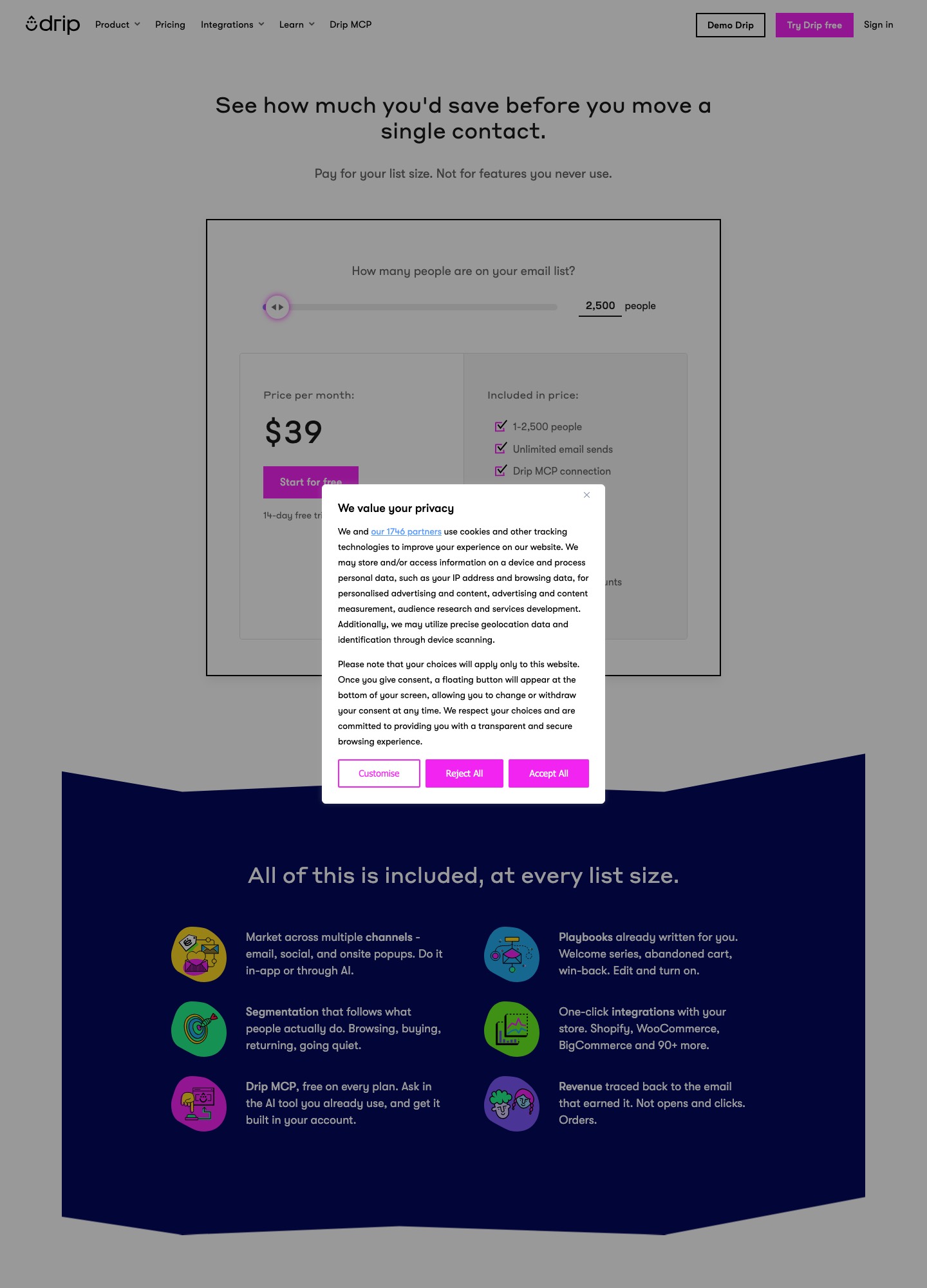
Drip's pricing page has no plan names. You move a slider for the people on your list and read a price: $39 for 1 to 2,500 people, $49 at 3,000, $89 at 5,000 and $154 at 10,000, with unlimited email sends listed in every tier I read up to 30,000 people. Against Omnisend that matters in one specific place. A store that needs room for 2,500 contacts is looking at Omnisend Pro, which I derived at $59 a month from the 251 to 500 selector and which lists a 2,500-contact allowance, against $39 on Drip. That is a difference of $20 a month, or 12 x $20 = $240 a year, with the caveat that Pro was not read at a 2,500-contact list. The cost of switching is at the small end: at 500 contacts Drip's $39 is $23 more than Omnisend Standard's $16, and Drip has no free plan, only a 14-day trial with no credit card.
What you gain is a tool built around store behaviour: its pricing page lists ecommerce revenue attribution, behaviour-based automations and dynamic segmentation, plus one-click integrations with Shopify, WooCommerce and BigCommerce. What you lose is the SMS side. Drip says SMS is available, with cost depending on subscribers and message segments, but I did not record a per-message rate, so you cannot price an Omnisend Pro SMS setup against it from this page. Migration is a contact import plus rebuilding flows; Drip's pricing page states free migration on its 25,000-person tier, so ask what it offers at your size. The ActiveCampaign vs Drip comparison covers the next step up if flows get complicated.
2. Klaviyo: the store-data ladder at almost the same price at 2,500
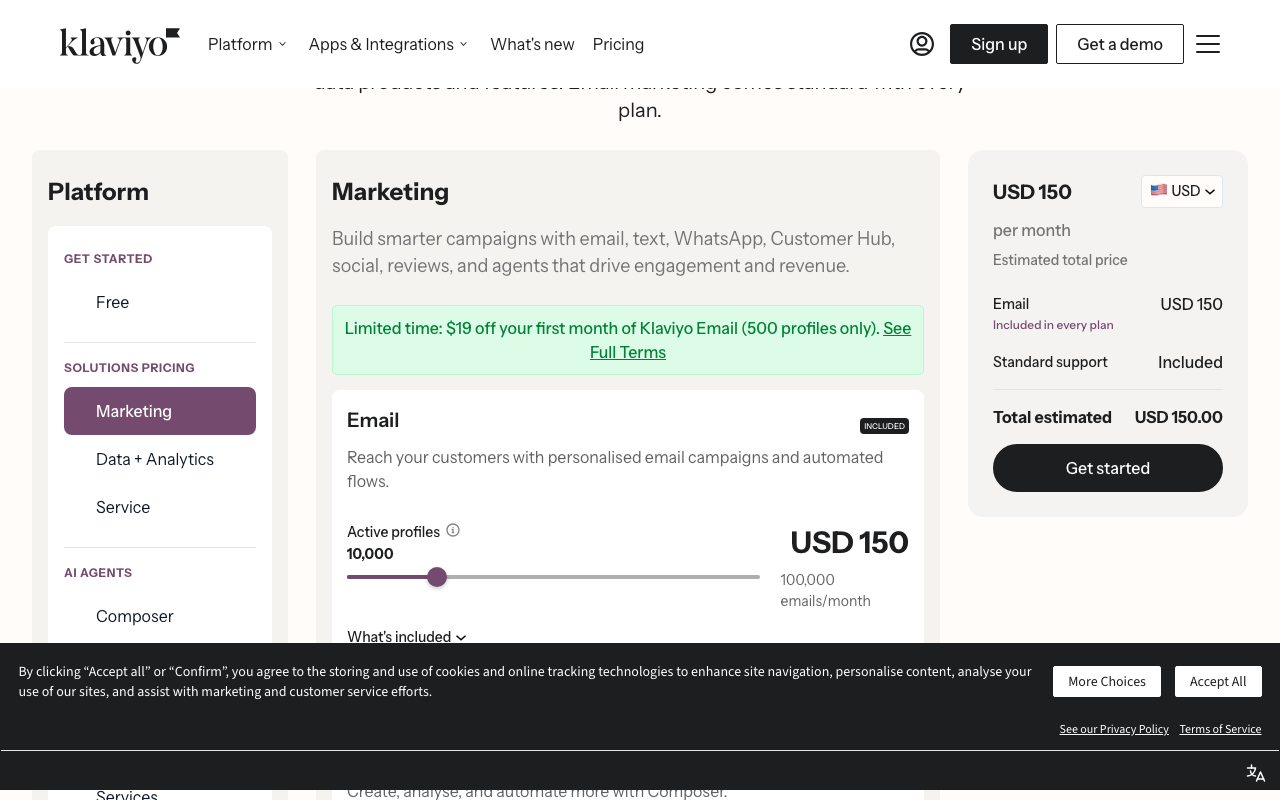
Klaviyo is the obvious commerce alternative, and Klaviyo's pricing page publishes a clean ladder: $20 at 500 active profiles, $30 at 1,000, $60 at 2,500, $100 at 5,000, $150 at 10,000 and $400 at 25,000. Its free plan, 250 profiles and 500 sends a month plus $5 of mobile messages, matches Omnisend's free email limits. Omnisend's own page advertises "Save up to 35% vs. Klaviyo"; on the two readings where I can line the ladders up, the gap is smaller. At 500 contacts Omnisend Standard's $16 is $4 under Klaviyo's $20. Omnisend Pro's $59, with its 2,500-contact allowance, is $1 under Klaviyo's $60 at 2,500 profiles, though Pro was read at the 251 to 500 selector. I did not read Omnisend at larger list sizes, so I cannot confirm or dispute the 35% there.
The practical differences are in the allowances. Klaviyo's 500-profile step lists 5,000 emails a month where Omnisend Standard lists 6,000, but at 2,500 profiles Klaviyo lists 25,000 emails and Omnisend Pro lists unlimited emails. Choose Klaviyo when you expect to grow past the sizes where I could price Omnisend, because Klaviyo's steps up to 25,000 profiles are all published. Do not choose it for SMS on this page's evidence: its calculator's Email plus SMS selector was not present when I captured it, so I have no Klaviyo SMS price. The Klaviyo alternatives page goes the other direction, for people leaving it.
3. Mailchimp: same allowance as Standard, a few dollars more
Mailchimp's pricing page lines up almost exactly with Omnisend at the bottom: its Standard plan starts at $20 a month for 500 contacts and 6,000 emails, which is the same two allowances Omnisend Standard lists at $16. The $4 monthly gap is $48 over a year. Mailchimp's Essentials plan starts at $13 for 500 contacts, with sends of 10 times the contact count, so 5,000 emails, and its free plan allows 250 contacts and 500 sends. The first-year offer on its page, $17 for Standard at 500 contacts, closes most of that $4 gap, but only for 12 months.
Above 2,500 contacts the gap opens. Standard in the 2,501 to 5,000 contact band lists $100 a month and up to 60,000 emails; the 5,001 to 10,000 band lists $135 and up to 120,000. I read Omnisend at only one selector position, so the $100 band cannot be set against an Omnisend figure here. Choose Mailchimp when the reason you are leaving is integrations or agency familiarity rather than price; the MailerLite vs Mailchimp page sets out the cheaper route.
4. MailerLite: the campaign-only exit, with EU data storage
For a store whose Omnisend use is mostly one or two campaigns a week, MailerLite's pricing page is the cheapest route I recorded. Comfort is $12 a month at 500 subscribers and Power is $25; at 1,000 subscribers they are $19 and $39, and at 5,000 they are $49 and $69. The send allowance on Comfort is ten times the subscriber tier's ceiling, so 5,000 emails at the 500 tier, against Omnisend Standard's 6,000, and Power lists unlimited emails. At 500 contacts the comparison is $12 against $16, a saving of $4 a month or $48 a year; Power at $25 sits $9 above Omnisend Standard but adds unlimited emails.
The trade is channel coverage. MailerLite's pricing page lists email automation, landing pages, websites and digital products, and I found no SMS price on it, so an SMS-heavy store would need a second vendor. In its favour, the page states that its data storage centre is in the European Union with an ISO 27001 certificate, and its free plan is 250 subscribers with 2,500 emails a month, five times Omnisend's 500-email free allowance at the same 250-contact size. Migration is a CSV import, then rebuilding automations, since flow definitions do not transfer between vendors.
5. Brevo: pay by emails sent, and keep a free tier that is daily
Brevo prices the other way round from Omnisend. Brevo's pricing page lets you pick a monthly email volume, and the plan tiers start at 5,000 emails: Starter at $9 and Standard at $18, with Professional from $499 for 150,000 or more emails. Its Free plan is 300 emails a day with up to 100,000 contacts stored, which for a list that rarely mails everyone at once can cover what Omnisend's 500-a-month free plan cannot. Yearly billing is displayed as $8.08 for Starter and $16.17 for Standard, and the yearly Standard figure lands within 17 cents of Omnisend Standard's $16, with A/B testing and advanced reports listed on Brevo's Standard plan.
The caveat is that I read no Brevo price at a given contact count. Its first paid tier lists storage for up to 500 contacts, so a 2,500-contact list is a question for Brevo's volume selector, not something to infer from the $9. Brevo also lists SMS campaigns and transactional SMS, WhatsApp campaigns, and an add-on to remove the "Sent by Brevo" sticker at $10.80 a month. It is the best fit for a store that wants one tool for promotional email and order notifications. See the Brevo alternatives page if you want the reverse route.
6. ActiveCampaign: only when automation is the reason you are leaving
ActiveCampaign's pricing page is the most capable route on this list for automation, and its Plus and Pro plans are the priciest at 2,500 contacts. At 2,500 email contacts, billed annually, Starter is $39, Plus $95, Pro $149 and Enterprise $255; at 5,000 contacts Starter is $79 and Plus $145. Starter limits an automation to 5 actions and one user, and its monthly sends are 10 times your contact limit, so 25,000 emails at 2,500 contacts. There is no free plan, only a trial.
Move here if your Omnisend flows have outgrown linear welcome and cart sequences and you need segmentation, which is where Plus ($95 at 2,500 contacts, standard segmentation and landing pages) and Pro ($149, advanced segmentation) differ from Starter. Do not move here to save money: Starter at 2,500 contacts is the same $39 as Drip but caps automations at 5 actions, and Omnisend Pro's $59 lists unlimited emails. Starter is also not offered at 50,000 contacts, where the page lists Plus from $609. The ActiveCampaign alternatives page covers what happens if you outgrow it in turn.
7. Shopify Email: free sending for the smallest Shopify stores
If your store is on Shopify, the cheapest Omnisend replacement is the app Shopify itself ships. Shopify's help page says the first 10,000 emails each month are free and pricing after that starts at $1 per 1,000 emails, and the Shopify App Store listing repeats it with "Free to install". A store that sends 6,000 emails a month, the whole Omnisend Standard allowance, pays $0 in sending fees; at 25,000 emails the arithmetic is (25,000 - 10,000) / 1,000 x $1 = $15.
The honest limit is that the Shopify pages I read describe sending price only. They say nothing I can quote about segmentation depth, multi-step flows, SMS or reporting, so treat this as the swap for stores that use Omnisend for plain campaigns and a couple of automations, and run a side-by-side before turning anything off. It is Shopify-only; a store on another platform cannot use it.
8. Postscript: leave email with Omnisend and move only the SMS
Omnisend Pro describes itself as best for senders adding SMS, so a real group of leavers are unhappy with the SMS side, not the email side. Postscript's pricing page is SMS and RCS marketing only: Starter has a $0 base with a $49 monthly minimum spend and $0.009 per SMS plus carrier fees; Growth is $100 a month at $0.008 per SMS; Professional is $500 a month at $0.007. Omnisend's headline SMS rate, $0.007, matches Postscript's Professional rate, but Postscript reaches it at a $500 plan fee, while Omnisend's calculator showed $50 for 5,882 SMS at $0.0085 on Pro.
At that same 5,882 messages, Postscript Starter costs 5,882 x $0.009 = $52.94 before carrier fees, against Omnisend's $50 estimate. The $49 minimum is crossed at 5,445 messages, so below that volume you pay the minimum regardless. Treat that $49 floor as a fixed cost when you weigh a split setup against Omnisend, where SMS credits are an extra purchase on top of Pro. A split makes sense when you want a dedicated SMS tool, with opt-in keywords on Postscript's Growth plan, and an email tool chosen separately; I would not choose it on price alone.
Omnisend's own price, summarised
Omnisend sells three self-serve plans, plus a Custom tier I did not record: Free (250 contacts, 500 emails), Standard ($16 a month undiscounted, for 500 contacts and 6,000 emails) and Pro ($59 undiscounted, for 2,500 contacts and unlimited emails), with SMS as an add-on to Pro from $0.007 a message. The $11.20 and $41.30 on the cards are the three-months-upfront display, as the screenshot above shows. Keep Omnisend if you use SMS and email in one automation and your list is inside 2,500 contacts; the moves above pay off when the list is growing past those two figures or when you only use one channel.
Cost at three list sizes
| Tool and plan | 500 contacts | 2,500 contacts | 5,000 contacts |
|---|---|---|---|
| Omnisend (Standard / Pro) | $16 ($48 / 3), Standard | Pro $59 ($177 / 3), read at the 251-500 selector; 2,500-contact allowance, not read at a 2,500 list | Not recorded |
| Drip | $39 | $39 | $89 |
| Klaviyo email | $20 | $60 | $100 |
| Mailchimp Standard | $20 | Not listed (band starts at $100) | $100 (band 2,501 to 5,000) |
| MailerLite Comfort | $12 | Not recorded | $49 |
| ActiveCampaign Starter | Starts at $15 for 1,000 | $39 | $79 |
Mailchimp, Klaviyo, Drip, MailerLite and ActiveCampaign figures are slider or plan readouts from each vendor's pricing page on 7 October 2026. ActiveCampaign figures are billed annually; MailerLite figures are monthly billing. Brevo, Shopify Email and Postscript price by email or SMS volume, so they are not in this table.
Switching from Omnisend
Contacts export as a CSV and import anywhere; what does not travel is the logic around them. Plan to rebuild automations, forms, templates and segment definitions by hand in the new tool, and use the first week to compare what each of your Omnisend flows actually sends. Write down the segment rules, wait times and exit conditions of your three most valuable flows, such as welcome, abandoned cart and post-purchase, before you open the new account.
Consent and suppression need more care than content. Export unsubscribed and bounced contacts as well as active ones and import them as suppressed before the first send, since unsubscribed contacts are not billed on Omnisend and are easy to leave behind. If you collect phone numbers, carry across the opt-in date and the source for each number; any SMS vendor, including Postscript, will want to see that record, so keep it with the contact file.
Run the pilot as a split: keep Omnisend live, send one campaign from the new tool to a 10% slice of the list that has opened recently, and compare delivery and revenue attribution before moving the rest. Leave flows running on Omnisend until the replacement has sent for a full billing cycle, since your Omnisend plan renews monthly after the three-month prepayment ends. If you are weighing tools in general, the guide to choosing an email tool has a checklist, and all alternatives pages are listed on the hub.
FAQ
Is Omnisend really $11.20 a month?
Only if you pay three months upfront. The card shows $11.20 for Standard but the small print says $33.60 today, down from $48.00, and that after three months you are billed monthly. Dividing the undiscounted $48.00 by 3 gives $16 a month; for Pro, $177.00 / 3 is $59.
Is Omnisend's free plan enough for a small store?
It covers 250 contacts, 500 emails and 500 web push notifications a month. That is two emails per contact at full size, so it suits a store testing flows rather than mailing weekly. Klaviyo and Mailchimp offer the same 250 contacts and 500 sends, while MailerLite's free plan allows 2,500 emails to 250 subscribers.
Which alternative is cheapest if I use SMS?
On the numbers I could read, none beats Omnisend Pro at small sizes. Its 5,882-SMS estimate of $50 compares with $52.94 for the same volume on Postscript Starter, before carrier fees, and Postscript's $49 minimum spend applies below about 5,445 messages. Postscript's lower per-message rates, $0.008 on Growth and $0.007 on Professional, come with $100 and $500 monthly plan fees.
Can I keep Omnisend for SMS and move email somewhere cheaper?
Yes, but you pay for Pro to add SMS, so the saving is the email part only. At 500 contacts the nearest swap is MailerLite Comfort at $12, which is $4 under Omnisend Standard, but SMS requires Pro at $59. Run the sums at your own list size before splitting the channels.