Automation platforms: two-product comparison
ActiveCampaign vs Drip: CRM-led automation or store-led email?
Short answer
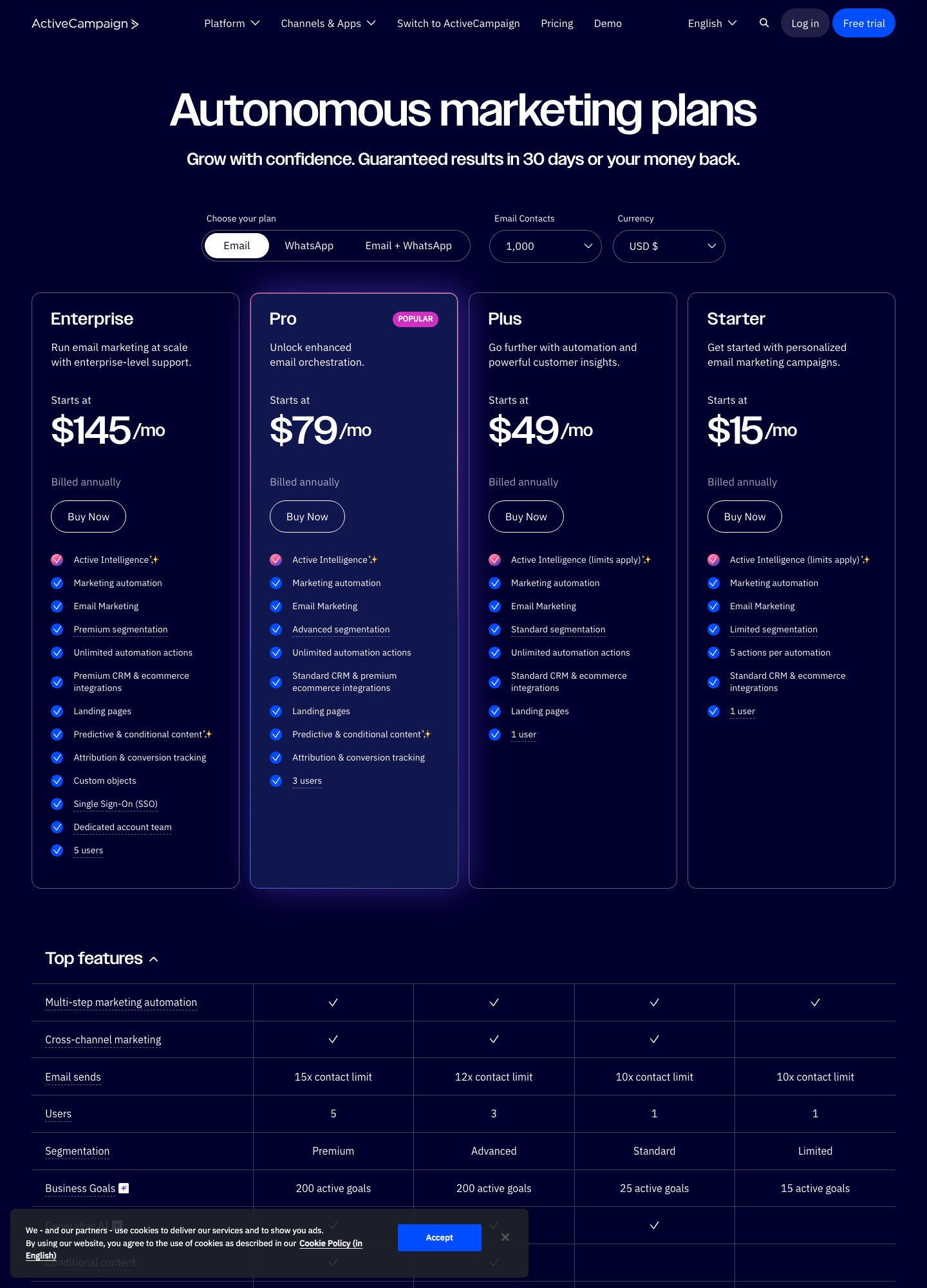
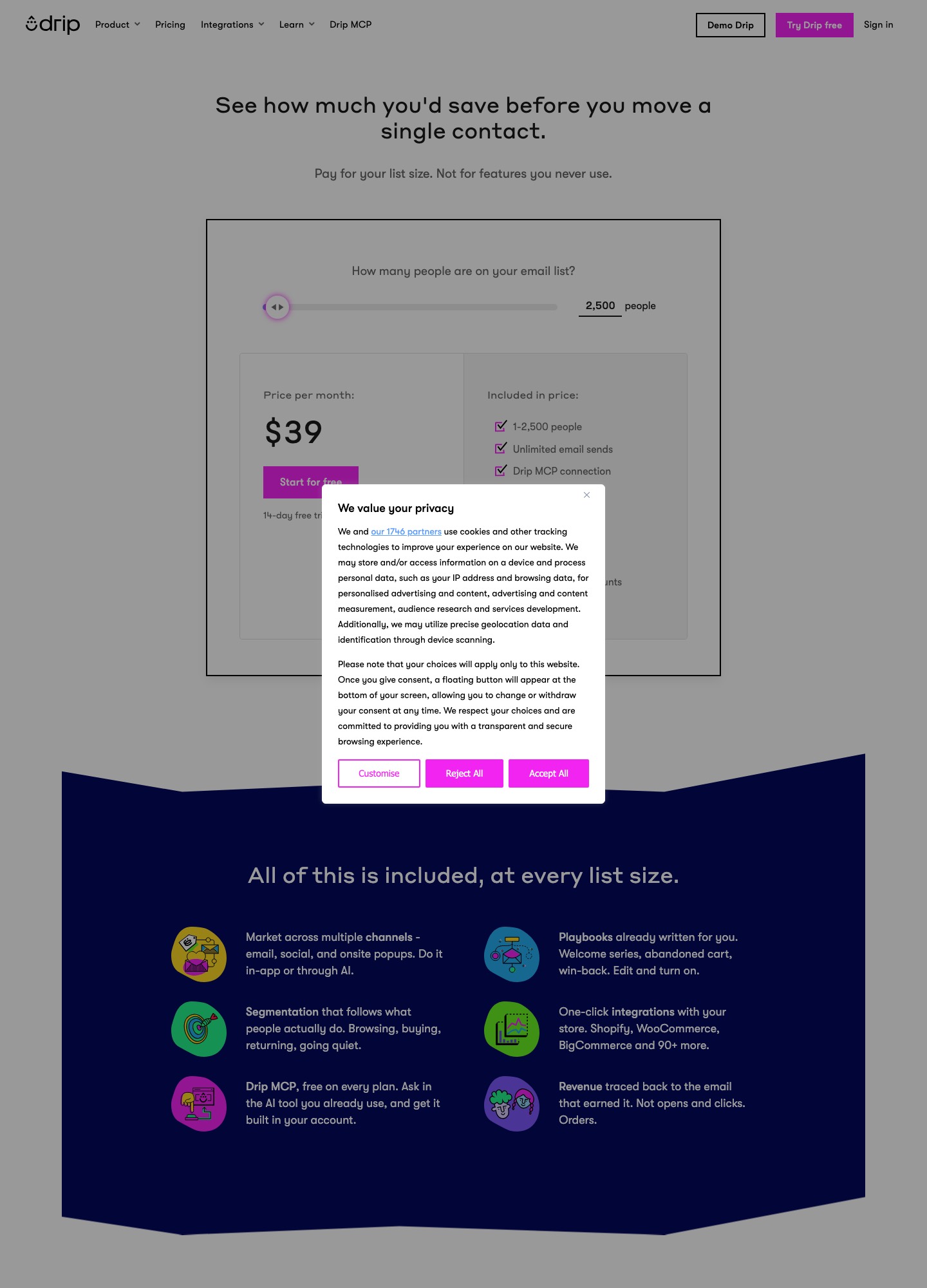
Pick ActiveCampaign when emails hand leads to salespeople and you need branching, deeper segmentation and a CRM view. Pick Drip when you sell products online and want email built around store events and revenue. Entry prices are close but billed differently: ActiveCampaign Starter is $15 a month at 1,000 contacts (Plus, the first plan without a cap on automation actions, is $49), billed annually, while Drip is one $39 monthly price covering 1 to 2,500 people, with a 14-day trial and no card.
Prices checked 7 October 2026 on the vendors' pricing pages.
Plans side by side
| ActiveCampaign | Drip | |
|---|---|---|
| Plans | Starter $15, Plus $49, Pro $79, Enterprise $145 per month at 1,000 contacts, billed annually | One plan; $39 a month for 1–2,500 people, higher bands as the list grows |
| What sets the price | The plan you choose and the contact count you pick | Active people in the account and the volume of email sent that month |
| Free option | Free trial; no free plan | 14-day trial, no credit card; no free plan |
| Automation limits | Starter: 5 actions per automation. Plus and up: unlimited actions | Up to 50 workflows included |
| Users | 1 on Starter and Plus, 3 on Pro, 5 on Enterprise | No user cap stated; unlimited sub-accounts |
| Segmentation | Limited on Starter, standard on Plus, advanced on Pro, premium on Enterprise | Dynamic segments on the base price |
| Monthly email sends | 10× contacts on Starter and Plus, 12× on Pro, 15× on Enterprise | Listed as unlimited email sends |
| Transactional and SMS | Transactional email and SMS sold as add-ons | Transactional billed within usage; SMS priced by subscribers and message segments |
Sources: ActiveCampaign pricing and Drip pricing, read on 7 October 2026.
What you pay per contact at the entry point
Drip's $39 buys a band, not a single list size. A shop with 1,000 subscribers pays $39, or about 3.9 cents a person, and a shop with 2,500 pays the same $39, about 1.6 cents a person. ActiveCampaign quotes by contact count and plan, and the figures we read are at 1,000 contacts: $0.015 each on Starter, $0.049 on Plus, $0.079 on Pro. Over a year, Plus costs $588 against $468 for Drip at that list size, though ActiveCampaign bills the year up front while Drip bills month by month and can be cancelled sooner.
The comparison that matters is the plan, not the contact count. Drip's single plan includes segmentation, onsite campaigns and up to 50 workflows. Starter does not match that, since it limits segmentation and caps each automation at five actions, so the like-for-like ActiveCampaign plan is Plus at $49, or Pro at $79 once you want conditional content and attribution. We did not capture ActiveCampaign prices above 1,000 contacts, so use its contacts selector for your own band.
What the $15 plan leaves out
ActiveCampaign Starter is the cheapest number on either page, so it is worth listing what it trades away: one user, limited segmentation, five actions per automation, 15 active goals, no cross-channel marketing, and a monthly send cap of 10 times your contact count. At 1,000 contacts that cap is 10,000 sends, which covers a twice-weekly newsletter (about 8,700 sends in a month) but not a daily one. Moving to Pro raises the cap to 12 times your contacts, so a 1,000-person list could be mailed 12,000 times. Drip lists unlimited email sends in its base price, so the same list on Drip is never held back by a cap, only by the usage rule discussed below.
ActiveCampaign: where it earns its price
ActiveCampaign's higher plans are built around the sales handoff. Pro adds advanced segmentation, predictive and conditional content, and attribution with conversion tracking, and sets aside three users. Pipeline features and sales engagement are sold as a CRM add-on, so a team that wants deals, owners and follow-up tasks next to email pays for that layer separately. The Enterprise plan adds custom objects, single sign-on, premium CRM and ecommerce integrations and a dedicated account team, for five users.
The trade-off is complexity and cost growth. Each plan limits "business goals" (15 on Starter, 25 on Plus, 200 on Pro and Enterprise), and the 1-user limit on Starter and Plus means a second marketer needs Pro. Prices are billed annually, so the $15 or $49 you see is a yearly commitment.
Drip: where it earns its price
Drip is organised around shoppers rather than leads. Its pricing page lists one-click integrations for Shopify, WooCommerce and BigCommerce plus more than 90 others, ready-made playbooks for a welcome series, abandoned cart and win-back, and revenue traced to the email that earned it. Segments are dynamic, following what people browse, buy, return or stop doing. For a store owner, that means the cart-abandonment flow is something to switch on and edit rather than build.
Included in the price are open API access, unlimited sub-accounts (useful to an agency running several shops), free migration help and personalised onboarding. The limits are the 50-workflow ceiling at the base price and a data model built for commerce, which suits a lead-generation team less. Drip also lists a Stripe integration, so subscription businesses are not shut out, but nothing on its page describes a sales pipeline.
Three situations, three different answers
| Situation | Better fit | Why |
|---|---|---|
| A consultancy with a three-person sales team nurturing 3,000 leads | ActiveCampaign Pro (from $79, quoted at 1,000 contacts and billed annually) | Three users, advanced segmentation, conditional content and a pipeline add-on all sit on one platform; check the selector for the 3,000-contact price |
| A Shopify store with 2,000 subscribers and no developer | Drip ($39 for up to 2,500 people) | Store events and prebuilt cart and win-back flows come ready, and the price does not move inside the band |
| A solo founder who wants a simple three-email welcome series on a tight budget | ActiveCampaign Starter ($15) | Five actions per automation is enough for a short series; move up if you need branching or a second user |
Reporting and revenue attribution
ActiveCampaign puts attribution and conversion tracking on Pro and Enterprise; the Starter and Plus plan cards do not list them. If you need to say which campaign produced a deal, plan on Pro. Drip's pricing page describes the opposite emphasis: revenue "traced back to the email that earned it", meaning orders rather than opens and clicks. That is the vendor's description and we have not tested it, so ask how it treats an order placed days after a click and compare Drip's number with your store dashboard for a month before you trust it for budget decisions.
Channels beyond email
ActiveCampaign lists cross-channel marketing on Plus, Pro and Enterprise but not on Starter. It also sells WhatsApp as its own plan type, with a selector for Email, WhatsApp, or both, and an SMS add-on that covers automated sends and reply triggers. Drip lists email, social and onsite pop-ups as its channels and offers SMS priced by subscribers and message segments. If WhatsApp is how your customers want to hear from you, only ActiveCampaign of the two sells it. If you want a pop-up on your store to collect addresses, Drip includes onsite campaigns in the base price.
AI features each vendor lists
ActiveCampaign brands its AI as Active Intelligence, with limits noted on Starter and Plus, and sells an AI activities add-on separately. Drip includes an MCP connection on every plan, which lets you ask an AI tool you already use to build things inside your Drip account. Both are conveniences, not reasons to pick a platform; check what each can actually do on a trial before you count it toward the decision.
The first three automations to build on each
On Drip, begin with the playbooks its page names: a welcome series, an abandoned-cart flow and a win-back flow. Edit the copy and connect your store, and the flows are ready to adjust rather than empty. Then make sure the cart reminders stop once an order arrives, and add a post-purchase message in their place, since reminding someone to buy what they already bought is an easy slip.
On ActiveCampaign, build a lead nurture first: a landing page or form feeds a short welcome, a wait and a second message that changes with what the person clicked (conditional content needs Pro). Second, a hand-off step that tells a salesperson when a lead is ready, which is where the CRM add-on's pipelines come in. Third, a re-engagement series for leads who have gone quiet. On Starter you will hit the five-action limit early, so count the actions before you build.
Questions to settle before you pay
- Drip, sends: the $39 band lists unlimited email sends, yet the page also says cost follows active people and the volume of email sent in the month. Ask support which one governs your bill, and what happens in a month with a big sale.
- Drip, counting: ask whether unsubscribed or never-engaged addresses count as active people.
- ActiveCampaign, band: check how the contact count you select is measured, and what the annual price becomes at renewal if your list has grown.
- ActiveCampaign, add-ons: transactional email, SMS and CRM pipelines are separate line items, so get each priced before comparing against Drip's all-in base.
- Both: confirm what leaves with you if you export, such as automations, segments and the history of what each person received.
Make the trial count
Drip gives you 14 days with no credit card and ActiveCampaign offers a free trial. Use that time on one real job. Import a few hundred real contacts, build the single automation that matters most to you, send it to yourself and a small seed list, and keep the trial going until the first real conversion event has been recorded. Try to run into the limits you are worried about: the five-action cap on Starter, the single user on Starter and Plus, the 50-workflow ceiling at Drip's base price. If neither tool reaches your first conversion within the trial, you have learned something worth more than the monthly fee. And if you only send a weekly newsletter, neither of these tools is the right fit; see newsletter best practices and the publishing platforms in the audience-building comparison.
Switching between them
Drip lists free migration in its base price, so moving from ActiveCampaign is the easier direction: ask them to import contacts and then re-create each automation as a Drip workflow. Count your automations first; a base-price Drip account holds 50 workflows. In the other direction, check how many people need logins, since ActiveCampaign's lower plans give you one, and list the store events you rely on, such as cart abandonment, because those need to be rebuilt from integration triggers. Keep the old tool running until a week of real sends has gone out cleanly.
FAQ
Is ActiveCampaign or Drip cheaper?
At 1,000 contacts ActiveCampaign Starter ($15) is cheapest, but Drip's $39 undercuts ActiveCampaign Plus ($49) and Pro ($79), which are the plans that match Drip's segmentation and workflows. Above 1,000 contacts, check each vendor's selector, since we only recorded ActiveCampaign at that size.
Does Drip have a free plan?
No. It offers a 14-day free trial with no credit card. ActiveCampaign also has no free plan, only a free trial.
Which is better for ecommerce?
Drip is built for it: its page highlights Shopify, WooCommerce and BigCommerce, prebuilt cart flows and revenue attribution. ActiveCampaign also integrates with Shopify and WooCommerce, but its strength lies in lead scoring and CRM-style automation.
Can either send transactional email?
Drip includes transactional email in its usage-based pricing. ActiveCampaign sells it as an add-on, so price it in if you need order confirmations or receipts from the same account.
More on this decision: Customer.io vs Drip, blast vs drip campaigns, how to choose an email tool and the alternatives hub.