Brevo alternatives for senders who outgrow its daily cap and volume tiers
Eight Brevo alternatives for senders who hit its 300-a-day cap or volume tiers: MailerLite, Amazon SES, Resend, SendGrid, Postmark and more, with prices.
Short answer
MailerLite is the best pick for most marketers leaving Brevo. Brevo's price follows emails sent, so a busier schedule raises the bill, while MailerLite's Power plan gives unlimited monthly emails at $39 for 1,000 subscribers and $69 for 5,000. Developers who send a lot should price Amazon SES at $0.16 per 1,000 emails, and anyone stuck on Brevo's free plan should look at EmailOctopus. Brevo's figures were read on 7 October 2026 from its pricing page and help article.
Why people leave Brevo
The free plan has a daily ceiling. Brevo's pricing help article says Free sends 300 emails a day, while allowing storage for up to 100,000 contacts. A list of 2,000 people therefore takes seven days to receive a single campaign (2,000 divided by 300 is 6.7), and 3,000 people take ten. Over a 30-day month the cap tops out at 9,000 emails, and the plan also limits marketing automation to 2,000 contacts.
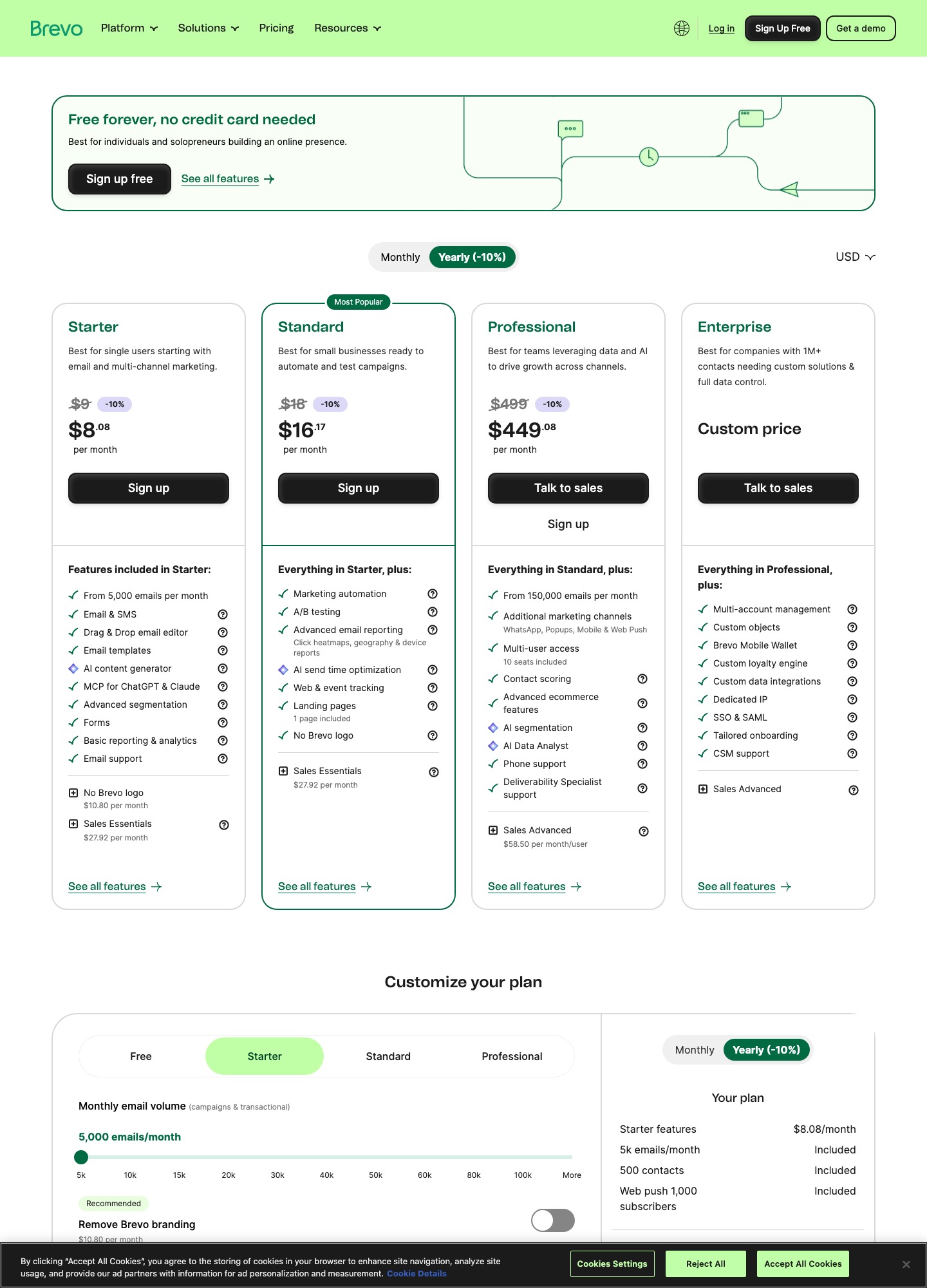
You pay for sends, so frequency is the lever. The article says the email volume you select determines your pricing tier. Starter begins at $9 a month and Standard at $18, both from 5,000 emails a month, and the first tier includes storage for up to 500 contacts. A 1,000-contact list mailed five times uses the whole 5,000 and the sixth send crosses into the next tier. A shop that mails more often pays more on Brevo even if the audience never grows.
The published steps skip a long way. The help article gives $9, $18 and then Professional at $499, which covers 150,000 to 10 million emails a month, up to 2 million contacts and 10 user seats. Everything between those numbers sits behind the volume slider. Teams that discover the answer only after they have built flows are the ones writing the "alternatives" searches.
Small extras add up. On Standard, extra seats are an add-on at $9 a month each, capped at 3 users in total, and the next step is Professional, which includes 10 users. On Starter, emails carry a "Sent by Brevo" logo in the footer, and the Remove Brevo logo add-on costs $9 a month according to the help article and $10.80 according to the pricing page; Standard, Professional and Enterprise show no logo. The Sales Essentials package is $31 a month. Yearly plans carry a 10 percent discount, which turns the $9 Starter readout into $8.08 a month.
It is a broad suite. The same account sends transactional email and SMS campaigns, and Brevo also lists WhatsApp campaigns, web and mobile push and sales tools. If you use only the broadcast feature you carry the rest without needing it, and if you use several, leaving means rebuilding each one somewhere new.
Quick comparison
| Alternative | Best if you | Billing unit | Price at two sizes | Free plan |
|---|---|---|---|---|
| MailerLite | mail often to a modest list | Active subscribers | Power $39 at 1,000; $69 at 5,000 | 250 subscribers, 2,500 emails a month |
| EmailOctopus | want a free list with a monthly, not daily, limit | Subscribers and emails | Pro $9 billed yearly at its 10,000 setting | 2,500 subscribers, 10,000 emails a month |
| Mailchimp | need five seats and wide integrations | Contact bands | Standard $100 at 5,000; $135 at 10,000 | 250 contacts, 500 sends a month |
| Elastic Email | want many sends for a small list | Plan with contact and email caps | Starter $29 and Pro $49, each for 2,500 contacts | 1,000 contacts, 3,000 emails a month |
| SendGrid | want API sending plus campaigns | Emails (API) or contacts (campaigns) | Email API Essentials $19.95 at 50,000; $34.95 at 100,000 | 2,000 contacts, 6,000 emails a month (campaigns) |
| Amazon SES | have developers and a very large volume | Per email sent | $8.00 at 50,000; $40.00 at 250,000 | Free plan for 6 months for new AWS customers |
| Resend | want API mail and broadcasts together | Contacts (marketing) or emails (API) | Marketing Pro $40 at 5,000; $80 at 10,000 | 1,000 contacts, unlimited broadcasts |
| Postmark | need separate streams for receipts and promotions | Emails per month | Basic $15 at 10,000; $55 at 50,000 | 100 emails a month |
Brevo's own entry points are Starter from $9 and Standard from $18, both at 5,000 emails a month, and Professional from $499. Figures for MailerLite, Mailchimp and Resend are read from each vendor's selector in monthly view.
Eight alternatives, split by why you are leaving
1. MailerLite: a flat price whatever your send frequency
Switch if your list is a few thousand people and you mail them often. MailerLite's pricing page prices by active subscribers: Comfort is $19 for 1,000, $49 for 5,000, $89 for 10,000 and $179 for 25,000, and Power is $39, $69, $129 and $239. Comfort allows 10 times the ceiling of your tier each month, so 1,000 subscribers can receive up to 10,000 emails, and Power has unlimited monthly emails. A list of 1,000 subscribers mailed daily is about 30,000 emails a month and stays at $39 on Power.
At the bottom of the range Brevo is cheaper. Its Starter is $9 for 5,000 emails, and MailerLite at a 500-subscriber tier is $12 monthly ($10.80 when billed yearly) for Comfort, or $25 ($22.50) for Power. The decision comes when volume rises: Brevo's price keeps following sends, while Power does not. MailerLite's free plan is 250 subscribers with 2,500 emails a month and 2 user seats, much smaller than Brevo's 300 a day, and it says its data storage center is in the European Union with an ISO 27001 certificate. For another view of MailerLite's position, read MailerLite vs Mailchimp.
2. EmailOctopus: a free list measured per month
Switch if the 300-a-day cap blocks your campaigns and the list is small. EmailOctopus Free covers 2,500 subscribers and 10,000 emails a month, with EmailOctopus branding on your emails, reports kept for 30 days, and 1 landing page, 1 form and 1 user. Its page lists a monthly allowance and no daily figure. Pro is $9 a month billed yearly at the 10,000 setting of its selector, with reports kept forever and unlimited landing pages, forms and users. Set the selector to your own list size and sending volume before you rely on that $9.
What you give up is room: Brevo Free stores up to 100,000 contacts, so a large dormant list does not fit in EmailOctopus Free. A 2,500-person list mailed once a week uses all 10,000 monthly emails over four weeks. The branding and thinner reporting suit a side project more than a business newsletter.
3. Mailchimp: five seats without the $499 jump
Switch if several colleagues need logins. Mailchimp's pricing page shows Free at 250 contacts and 500 sends a month (250 a day), which is tighter than Brevo's daily 300. Paid: Essentials starts at $13 a month at 500 contacts with 3 seats and sends up to 10 times your contact count; Standard starts at $20 with 5 seats and 12 times; Premium at $350. For larger lists Standard is $100 for 2,501 to 5,000 contacts (up to 60,000 emails), $135 for 5,001 to 10,000 (120,000 emails) and $230 for 10,001 to 15,000.
Seats are the cleanest comparison, and Mailchimp is not the cheaper entry point: Brevo Standard starts at $18 against Mailchimp Standard's $20. The difference is the ceiling. Brevo's help article caps Standard at 3 users in total and puts the next step at Professional, from $499 with 10 users, while Mailchimp Standard lists 5 seats and Premium unlimited users. The offer on the page, 50 percent off for 12 months, halves the first year's price at the 2,501 to 5,000 band to $50 before $100 applies. The cost is that contacts, not sends, set the price, and the 500-sends-a-month free plan makes Mailchimp a worse starting point than Brevo for the smallest senders.
4. Elastic Email: a lot of sends for a small list
Switch if you have under 2,500 contacts and mail them very frequently. Elastic Email's pricing page lists Starter at $29 a month for up to 2,500 contacts and 37,500 emails, with a single automation, and Pro at $49 for the same limits with advanced automation and user management. Its Free plan is up to 1,000 contacts and 3,000 emails a month with a limit of 100 a day, below Brevo's 300 a day. An Email API plan is separate: Starter $19 for up to 50,000 emails and Pro $49, which adds inbound email processing and webhooks.
At Brevo's entry tier, $18 buys 5,000 emails on Standard, which is $3.60 per 1,000. On Elastic Email Starter, $29 covers 37,500, which is $0.77 per 1,000 ($29 divided by 37.5). That per-email economy is the case for switching, and the cost is a 2,500-contact ceiling at that price, with a single automation on Starter.
5. SendGrid: API sending and a campaign tool in one vendor
Switch if developers send most of your volume. SendGrid's pricing page splits two products. Email API Essentials is $19.95 at 50,000 emails and $34.95 at 100,000, and Pro is $89.95 at 100,000 and $249 at 300,000 with a dedicated IP included. Marketing Campaigns is free for up to 2,000 contacts and 6,000 emails a month, then Basic from $15 for up to 100,000 contacts and 300,000 emails, and Advanced from $60 for up to 200,000 contacts and 1,000,000 emails with dedicated IP access.
At the first paid step SendGrid Marketing Basic ($15) sits between Brevo Starter ($9) and Standard ($18), but it covers far more sends in the selector, up to 300,000. The free plan's 2,000-contact limit is the thing to watch if you move from Brevo's 100,000-contact storage. Brevo vs SendGrid goes through the pair feature by feature.
6. Amazon SES: the cheapest sender, with the least built in
Switch if the volume is large, your engineers can build the rest, and the price per email is what hurts. Amazon SES's pricing page lists Essentials at $0.16 per 1,000 emails, Pro at $0.22 per 1,000 with $105 per account per region per month, and Enterprise at $0.23 per 1,000 with $500 per account per region per month. 10,000 emails cost $1.60, 50,000 cost $8.00 and 250,000 cost $40.00 on Essentials. A standard dedicated IP is $24.95 a month. New AWS customers get a free plan for 6 months with up to $200 in credits.
The price list is a rate card for sending and receiving, not for a drag-and-drop editor, list management or reports. Someone has to build or buy those, and handle bounces and unsubscribes, before it can replace a Brevo campaign workflow. It is a backend swap for the transactional half of Brevo, and a poor move for a marketing team without engineering help.
7. Resend: broadcasts and application mail from one API
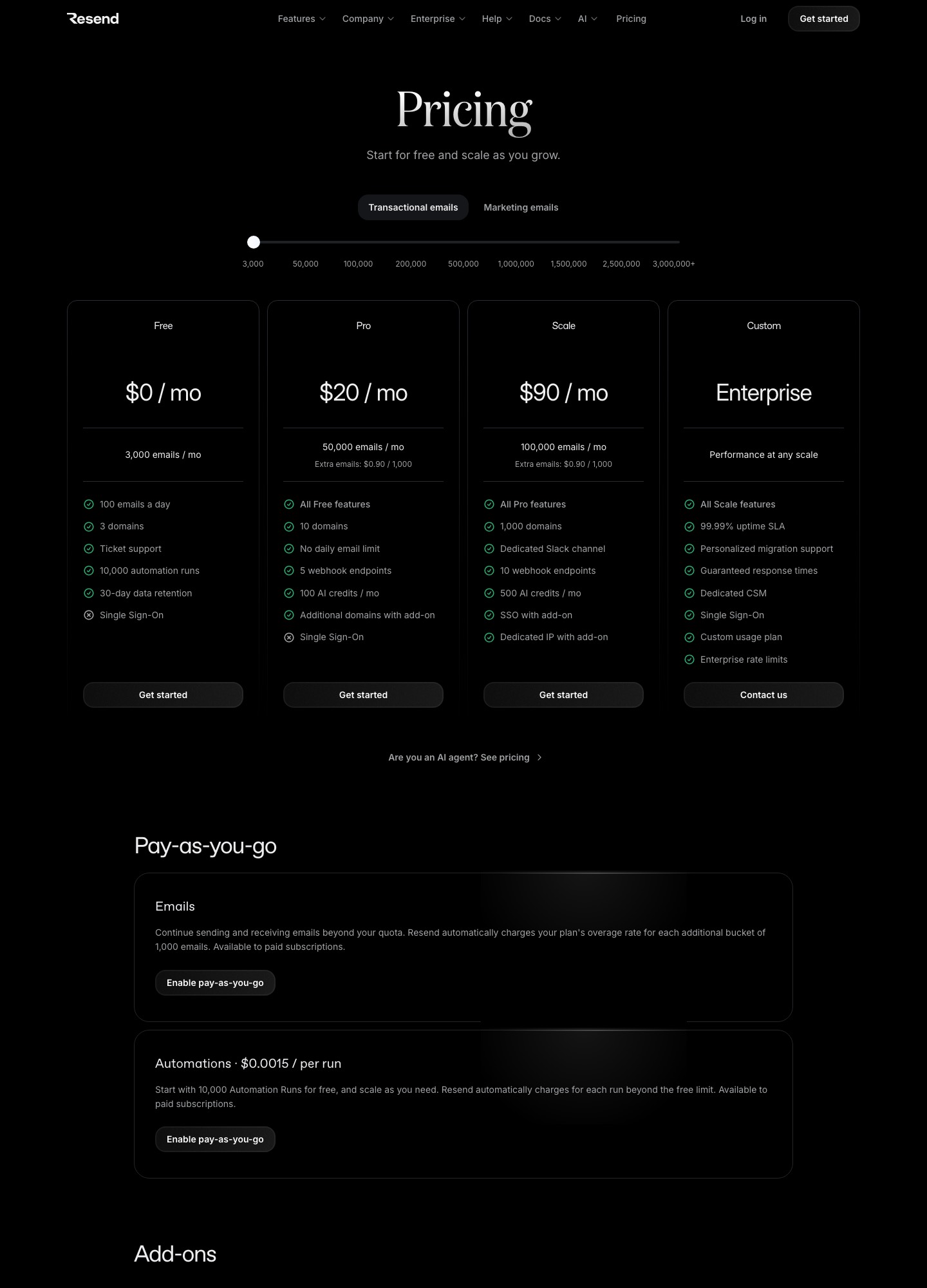
Switch if your product sends mail from code and marketing wants to send broadcasts without a second vendor. Resend's pricing page has a Marketing tab: free at 1,000 contacts with unlimited broadcast sending, 10,000 automation runs and 3 segments, then Pro at $40 for 5,000 contacts, $80 for 10,000, $180 for 25,000, $250 for 50,000 and $450 for 100,000. The transactional tab is separate: Free is 3,000 emails a month with 100 a day and 3 domains, Pro is $20 at 50,000 and $35 at 100,000, and Scale is $90 at 100,000.
The free marketing plan lists no daily cap, which removes the 300-a-day wall, but it holds 1,000 contacts rather than 100,000. Brevo's SMS and WhatsApp campaigns have no counterpart on the Resend pages read here, so those channels need their own vendor. Read Resend vs Postmark before choosing between the two developer tools.
8. Postmark: receipts and promotions on separate streams
Switch if your biggest worry is that a promotional complaint would delay a password reset. Postmark's pricing page lists Basic at $15 for 10,000 emails, $55 at 50,000 and $115 at 125,000, with Pro at $16.50, $60.50 and $126.50 and Platform at $18, $66 and $138. Basic has 45-day data retention, extra emails are $1.80 per 1,000, and Free is 100 emails a month. A dedicated IP starts at $50 a month, but only for customers sending 300,000 emails a month or more on Pro or higher.
Postmark's pricing page lists transactional message streams (up to 30 on its plan comparison), so receipts, alerts and promotions can sit in separate streams of one account. Brevo offers transactional email and campaigns together too, so the reason to move is the separation you want, not a missing feature. Postmark vs SendGrid compares its cost at 50,000 and 300,000 emails with SendGrid's.
Brevo's own pricing in short
Free is 300 sends a day. Starter starts at $9 and Standard at $18 from 5,000 emails a month, with the first tier storing up to 500 contacts, and Professional starts at $499. The capture below shows the page as read, with Resend's page after it.
Switching from Brevo
Contacts and attributes. Export each list as a file with its attributes, and note which people were in which list, since Brevo's storage and automation limits are counted separately. Blocklisted contacts, unsubscribes and hard bounces go in a second file.
What has to be rebuilt. Automations, forms and templates are rebuilt by hand, and a template moves as HTML rather than as an editable layout. If you use SMS, WhatsApp, push or the sales tools, none of the alternatives above replaces all of them; Omnisend's page, for instance, lists SMS from $0.007 per message. For transactional mail, you replace the SMTP or API credentials in your application and add the sending domain's SPF and DKIM records at the new provider.
Consent and suppression. Brevo's privacy policy has a section on transfers outside the European Economic Area and it offers a DPA, so sort out your data-processing paperwork with the new vendor before you move any personal data. Upload the suppression file before the first campaign, and keep the original opt-in date and source for each address.
The pilot. Send one real campaign through the new tool to a group of 200 to 500 recipients and compare bounces and unsubscribes with the same group's last Brevo send. Run transactional mail in parallel before you cut over. The bulk sending guide covers warm-up pacing, the transactional vs marketing note explains why the two streams should stay apart, and the tool-selection guide is a good place to start if the shortlist feels too long.
Cost at two scales
First, tools that price by list size, read in the monthly view.
| Plan | 1,000 contacts | 5,000 contacts | 10,000 contacts |
|---|---|---|---|
| MailerLite Comfort | $19 | $49 | $89 |
| MailerLite Power | $39 | $69 | $129 |
| Mailchimp Standard | $20 at 500 contacts | $100 | $135 |
| Resend Marketing | $0 | $40 | $80 |
Second, tools that price by emails sent, read on the volume selector or computed from a per-1,000 rate.
| Plan | 10,000 emails | 50,000 emails | 100,000 emails |
|---|---|---|---|
| Amazon SES Essentials | $1.60 | $8.00 | $16.00 |
| Postmark Basic | $15 | $55 | Not a slider stop (125,000 is $115) |
| SendGrid Email API Essentials | Below the 50,000 minimum | $19.95 | $34.95 |
| Resend Pro | Free covers 3,000; Pro starts at 50,000 | $20 | $35 |
| Brevo Starter / Standard | From $9 / $18 at 5,000 emails a month; larger volumes are set on Brevo's selector | ||
Amazon SES figures are 10 x $0.16, 50 x $0.16 and 100 x $0.16, with no data transfer or add-ons. At each plan's entry volume the cost per 1,000 emails is $1.80 on Brevo Starter and $3.60 on Brevo Standard. See also ActiveCampaign alternatives for a contact-priced incumbent, all alternatives pages, and the tools directory.
Choose by situation
- Pick MailerLite when you mail a few thousand people weekly or daily and want the bill to stay flat.
- Pick EmailOctopus when you have up to 2,500 subscribers and the 300-a-day cap is the only problem.
- Pick Amazon SES when engineers can build the campaign layer and you send 50,000 or more emails.
- Pick Resend or Postmark when your application mail comes first and you want it, and the stream your campaigns use, handled by a vendor with an API-first product.
- Stay on Brevo when you rely on its SMS, WhatsApp or push channels, or mail a large list only a few times a month.
FAQ
Why does Brevo's free plan stop me from sending to my whole list?
Free sends 300 emails a day. A 2,000-person list needs seven days to receive one campaign, even though the plan can store up to 100,000 contacts. Starter removes the daily limit from $9 a month at 5,000 emails.
Is Brevo cheaper than Mailchimp?
By a small margin at the entry tier. Brevo Standard starts at $18 for 5,000 emails, with seats capped at 3 users in total, while Mailchimp Standard starts at $20 for 500 contacts and lists 5 seats. For lists of 5,000 or more, Mailchimp lists $100 and $135, and Brevo's price depends on the volume you set.
What replaces Brevo's transactional email?
Postmark, Resend, SendGrid and Amazon SES all send application mail. Amazon SES is the lowest per email, at $0.16 per 1,000. Postmark lists message streams from $15 for 10,000 emails.
Can I keep Brevo for transactional mail and move only campaigns?
Yes, and it is a common compromise: move broadcasts to MailerLite or Mailchimp and leave the application credentials alone. Keep the two sending identities and suppression lists consistent so a person who unsubscribes on one side is not mailed from the other.