Email platforms: two-product comparison
Brevo vs SendGrid: one platform for everything, or a sending service plus a campaign tool?
Short answer
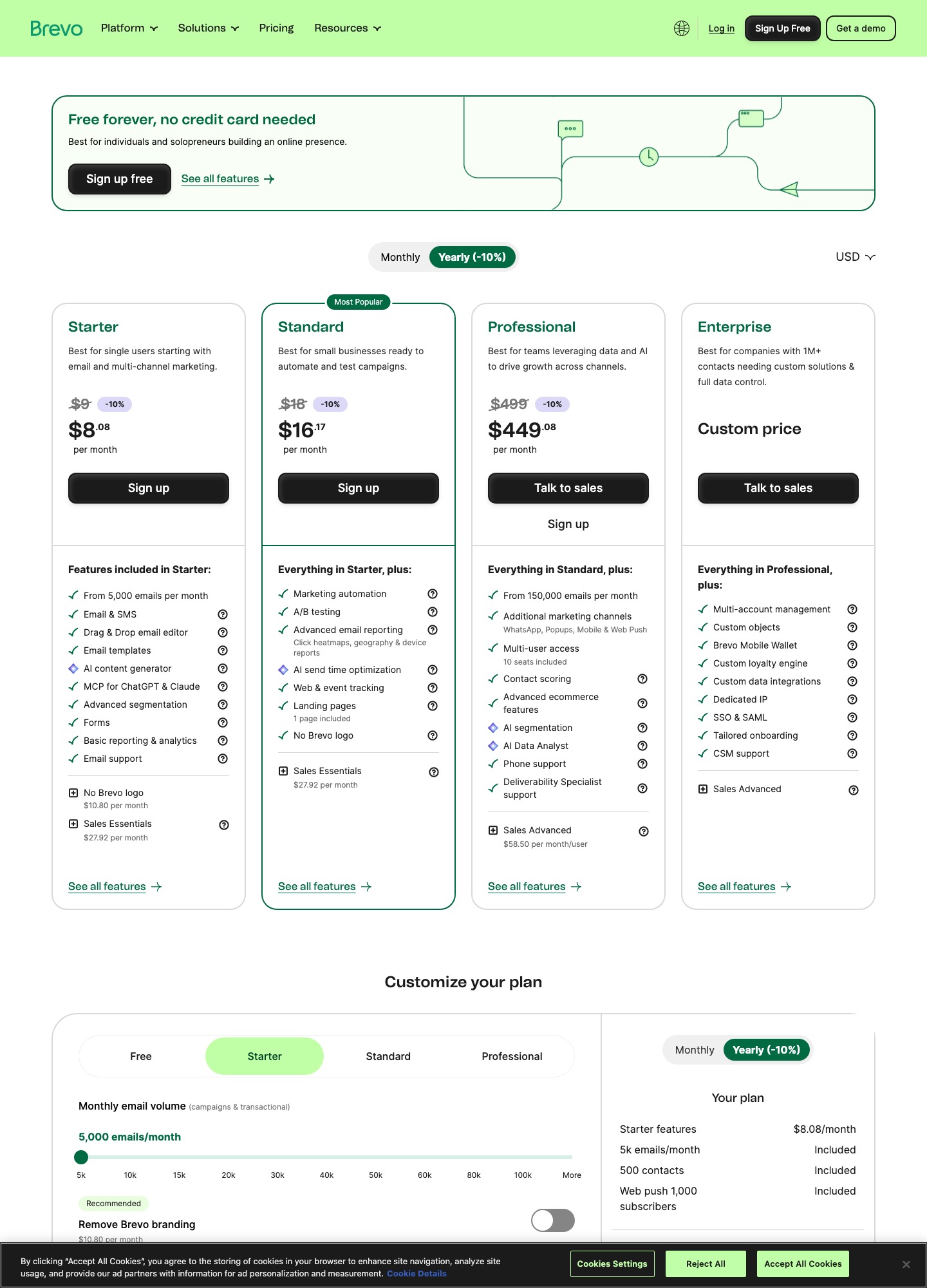
Choose Brevo if you want newsletters, automation, transactional email and SMS behind one login, with a free plan that sends 300 emails a day. Choose SendGrid if your application sends mail through an API and you want sender-reputation tooling such as dedicated IPs, or if you already build on Twilio. The wrinkle is that SendGrid sells two separate products. Email API starts at $19.95 a month (Essentials) and $89.95 (Pro); Marketing Campaigns has a free plan for 2,000 contacts and 6,000 emails a month, then Basic from $15 and Advanced from $60. Brevo's pricing article lists Starter from $9 a month, Standard from $18 and Professional from $499.
Prices checked 7 October 2026. Every price here is a starting price: both vendors move it with the monthly email volume you select.
Plans and limits side by side
| Brevo | SendGrid Email API | SendGrid Marketing Campaigns | |
|---|---|---|---|
| What it is | One platform: email and SMS campaigns, transactional email and SMS, automation, web push, built-in sales tools and live chat | SMTP and REST API sending for applications, with analytics and deliverability tooling | Design and code editors, segmentation, A/B testing, automation and signup forms for marketers |
| Free option | Free forever: 300 sends a day, storage for up to 100,000 contacts, 1 user seat, automation for up to 2,000 contacts | Free trial: 100 emails a day for 60 days | Free plan: store up to 2,000 contacts, send 6,000 emails a month |
| Entry paid plan | Starter from $9/month: 5,000 emails a month, up to 500 contacts, no daily limit | Essentials from $19.95/month (50,000–100,000 emails a month in its selector) | Basic from $15/month (selector reaches 100,000 contacts and 300,000 emails) |
| Middle plan | Standard from $18/month: automation for unlimited contacts, A/B testing, advanced reports, AI send-time optimization, 1 landing page, priority email support | Pro from $89.95/month (100,000–2,500,000 emails a month) | Advanced from $60/month (selector reaches 200,000 contacts and 1,000,000 emails) |
| Top plan | Professional from $499/month: 150,000 to 10 million sends, up to 2 million contacts, 10 seats; Enterprise custom | Premier, custom pricing | Custom pricing |
| Dedicated IP | Add-on on Professional and Enterprise, $251 a year; 1 included on Enterprise | 1 included on Pro and Premier | Access to dedicated IPs on Advanced |
| Team seats | Standard up to 3 (extra seats $9 a month each), Professional 10, Enterprise unlimited | 1 teammate on Essentials, 1,000 on Pro | 1 teammate on Basic, 1,000 on Advanced |
| Support | Email on Free, priority email on Standard, phone and priority email on Professional | Expert and personalized support available to purchase | Ticket on the free plan; ticket, chat and phone on Basic; guaranteed response times on Advanced |
Sources: Brevo's pricing plans article and Brevo pricing, SendGrid Email API pricing and SendGrid Marketing Campaigns pricing, read on 7 October 2026. Brevo's yearly billing takes 10% off the figures shown; SendGrid's starting prices carry taxes and possible overages.

How each one meters your sending
Brevo asks you to pick a monthly email volume, and the volume you pick sets the plan tier and also the number of contacts the account can store. The pricing article lists the pairs for Starter and Standard: 5,000 emails with up to 500 contacts, 10,000 with up to 1,500, 15,000 with up to 2,500, then 20,000 and up with storage up to 500,000. Campaigns and transactional email draw on the same volume. The pairing has a practical effect. A 1,000-contact list mailed weekly needs about 4,300 sends a month, which would fit the 5,000-email tier on volume alone, but that tier stores only 500 contacts, so you buy the 10,000-email tier. On its first three tiers (500, 1,500 and 2,500 contacts) Brevo warns you as you approach the limit and then moves you up to the next tier on its own when you reach it, so a large import raises the bill.
SendGrid meters each product separately. On Email API, one email to one recipient takes one credit, even if the message is later deferred or filed as spam, and mail sent through Marketing Campaigns is counted apart from API mail. Marketing Campaigns limits contacts and emails together, in fixed pairs, and charges a published rate for each extra email or contact:
| Marketing Campaigns plan | Contacts stored | Emails per month | Cost per extra email or contact |
|---|---|---|---|
| Basic 5K | 5,000 | 15,000 | $0.0040 |
| Basic 20K | 20,000 | 60,000 | $0.0030 |
| Advanced 10K | 10,000 | 50,000 | $0.0075 |
| Advanced 50K | 50,000 | 250,000 | $0.0060 |
Run the arithmetic on your own cadence. A 5,000-contact list mailed weekly is about 21,700 sends a month; on Basic 5K that is roughly 6,700 over the 15,000 allowance, or about $27 at $0.0040 each. On Advanced 10K, mailing 10,000 contacts every day would be 300,000 sends, 250,000 over the allowance, which at $0.0075 is $1,875. Overage is a safety net, not a way to run a daily program; that case calls for a bigger plan. The rates come from the table on SendGrid's Marketing Campaigns pricing page, which links to its overage article.
What the free options cover at a real list size
Brevo's Free plan is capped per day, not per month. At 300 sends a day, a campaign to 1,000 contacts takes four days to go out in full, and a campaign to 2,000 contacts takes seven. A list can be large (storage is listed up to 100,000 contacts), but a free account mails it slowly, and the 300 is a plan-wide daily allowance, so check how your transactional mail counts against it. SendGrid's Marketing Campaigns free plan is capped per month instead: 2,000 contacts stored and 6,000 emails, which is exactly three sends to a 2,000-person list.
The free route for application mail is different. SendGrid's Email API offers a free trial of 100 emails a day for 60 days, then a paid plan from $19.95. Brevo's pricing article lists transactional email and transactional SMS on its free-forever plan.
Sending from an application
SendGrid's Email API is the product designed for this job. Its pricing page lists SMTP and a REST API, client libraries for Node.js, Ruby, Python, Go, PHP, Java and C#, an event webhook (1 included on the trial, 2 on Essentials, 5 on Pro), dynamic templates with a design editor and, on Pro, template testing, and searchable email activity that is kept for 3 days on Essentials and 7 on Pro. Pro also bundles 2,500 free address validations, and Premier 5,000.
Brevo covers the same ground inside its marketing platform: transactional email and transactional SMS are on its plan list from Free up, outbound webhooks are on Free and inbound webhooks arrive at Professional. The difference is the meter. Brevo's volume setting covers campaigns and transactional mail together, so a store sending order confirmations and a weekly newsletter buys one allowance. At SendGrid the same store would hold an Email API plan and a Marketing Campaigns plan, each with its own counter. That is fine for a product team that wants API mail billed on its own, and awkward for a small shop that just wants one bill.
Deliverability tooling each vendor documents
SendGrid's Email API page lists domain authentication with SPF and custom DKIM, link branding, reverse DNS, suppression management, a deliverability insights dashboard, dedicated IP pooling and automated dedicated-IP warm-up. It also states 99.999% uptime for its distributed architecture; that is the vendor's own figure. Dedicated IPs are included once, on Pro and Premier. The Marketing Campaigns page lists authentication, sender profiles and unsubscribe groups, with dedicated-IP access on Advanced.
Brevo sends from a shared IP used by many customers unless you add a dedicated one, which its article prices at $251 a year and offers on Professional and Enterprise (Enterprise includes one). Professional also lists 3 hours a year with a deliverability strategist, and the plan card names deliverability specialist support. Below Professional, you rely on the shared pool and on your own list hygiene. So a sender that wants its own IP and reputation at a modest volume reaches that sooner on SendGrid Pro ($89.95 and up) than on Brevo Professional ($499 and up), and the $409.05 gap between those two starting prices buys Brevo's marketing suite, 10 seats and 150,000-plus monthly sends as well.
Where Brevo goes wider on marketing
Brevo's Starter plan includes email and SMS campaigns, a drag-and-drop editor, advanced segmentation and web push. Standard at $18 adds automation for unlimited contacts, A/B testing, advanced reports, send-time optimization and one landing page; Professional raises that to ten landing pages and adds WhatsApp campaigns and contact scoring. Every plan, Free included, comes with sales tools such as a pipeline with 50 open deals, meeting scheduling and live chat. Starter emails carry a "Sent by Brevo" footer logo unless you add the $9-a-month removal add-on, while Standard and above show no logo. Extra seats on Standard cost $9 a month each, up to 3 users.
SendGrid's Marketing Campaigns plans give you design and code editors, segmentation, A/B testing, signup forms (1, 5 or 15 by tier) and email-testing credits (3, 10 or 60). Automation is the gate to check: the plan cards list it on the free tier and on Advanced but not in Basic's feature list, so confirm that Basic includes it before you plan a drip series there. SendGrid's pricing pages mention no SMS or chat, since those sit in other Twilio products.
Choose Brevo if…
- one small team sends both a newsletter and its application's receipts or alerts and wants a single volume, a single bill and a free plan to begin on;
- SMS, web push, WhatsApp (Professional) or the built-in sales pipeline and live chat are part of the plan;
- you want automation, A/B testing and send-time optimization for $18 a month at Standard rather than SendGrid Advanced's $60;
- your list is a few thousand contacts at most, which Brevo's first three tiers (500, 1,500 and 2,500 contacts) are sized for.
Choose SendGrid if…
- developers own the sending and want an API, client libraries, event webhooks, suppression handling and email-activity search billed as their own product;
- you need a dedicated IP with automated warm-up on a plan that starts at $89.95 (Pro) rather than $499;
- you are already on Twilio and want email under the same vendor;
- you need seats for many people: both SendGrid products list 1,000 teammates on their upper plans, against 10 on Brevo Professional.
Brevo is also easy to over-buy: its sales packages, extra seats and prepaid message credits are add-ons, so price the base plan first. For a developer-led shortlist, Postmark vs SendGrid and SendGrid vs Mailgun set SendGrid against two API-first rivals, SendGrid alternatives and Brevo alternatives cover wider options, and the transactional vs marketing email post explains why the two kinds of mail are usually kept apart. High-volume senders can start from our high-volume sending page.
Moving between them
Coming from SendGrid's Email API to Brevo, the sending path changes before anything else: re-create your domain authentication (SPF and DKIM) in Brevo, point your application at its sending credentials, and re-export your suppression lists so bounced and unsubscribed addresses are not mailed again. SendGrid's dynamic templates have to be rebuilt in Brevo's editor, and anything that consumes SendGrid's event webhook needs to be repointed at Brevo's webhooks. If you were on a SendGrid dedicated IP, remember Brevo's equivalent starts at the Professional plan, and a new IP needs warming either way; SendGrid lists automated warm-up on its side.
Coming from Marketing Campaigns, export contacts and custom fields as a CSV, then import them in one pass. Because Brevo ties contact storage to the email volume you choose, count the list first and select the volume tier that stores it. Automations are rebuilt by hand, and Brevo's automation for unlimited contacts starts on Standard (the free plan caps it at 2,000). Going the other way, check that Brevo's contact total fits one of SendGrid's fixed contact-and-email pairs, and decide whether application mail should move to Email API as a second, separately metered plan.
If you only want to try the other side, SendGrid's Marketing Campaigns free plan and Brevo's free plan both need no payment, and both are tight on purpose: Brevo stops at 300 sends a day and SendGrid at 6,000 a month.
FAQ
Is Brevo cheaper than SendGrid?
At the entry level, yes: Brevo Starter starts at $9 a month and Standard at $18, against SendGrid Email API Essentials at $19.95 and Marketing Campaigns Advanced at $60. SendGrid's Marketing Campaigns Basic at $15 sits between them. Each vendor moves its price with volume, so enter your monthly send count on both pages before concluding anything.
Does SendGrid have a free plan?
Marketing Campaigns has one: up to 2,000 stored contacts and 6,000 emails a month. The Email API has a 60-day trial of 100 emails a day instead. Brevo's Free plan sends 300 emails a day and stores up to 100,000 contacts, with no time limit.
Can Brevo replace SendGrid for transactional email?
For many small senders, yes. Brevo's pricing article lists transactional email and SMS on every plan, and the volume you choose covers campaigns and transactional mail together. SendGrid is the better match when developers want its API tooling, per-product billing and a dedicated IP from $89.95 rather than $499.
Which one includes a dedicated IP?
SendGrid's Email API includes one on Pro and Premier, and Marketing Campaigns gives access to dedicated IPs on Advanced. Brevo sells a dedicated IP as an add-on at $251 a year on Professional and Enterprise, with one included in Enterprise.
Which is better for a newsletter with a few thousand subscribers?
Brevo, for most small lists: its Starter and Standard tiers step up at 500, 1,500 and 2,500 contacts and include editor, forms and segmentation. SendGrid Marketing Campaigns is a fair choice if you want its free 6,000-email plan or Basic at $15 and you are fine with its fixed contact-and-email pairs.