beehiiv alternatives for publishers who have outgrown the free plan
Eight beehiiv alternatives priced at 5,000 and 10,000 subscribers: Kit, Ghost, Substack, Buttondown, MailerLite, Flodesk, EmailOctopus and Resend.
Short answer
Kit is the best pick for most people leaving beehiiv. Its free plan covers up to 10,000 subscribers with unlimited broadcasts, while beehiiv's Lite plan at the same size is $119 a month on yearly billing ($139 monthly) and $95 ($109) at 5,000. Choose Substack if you charge for the newsletter and would rather pay a share of revenue than a monthly fee, and Ghost if you want to own the website as well. beehiiv figures were read on 7 October 2026 from its slider.
Why people leave beehiiv
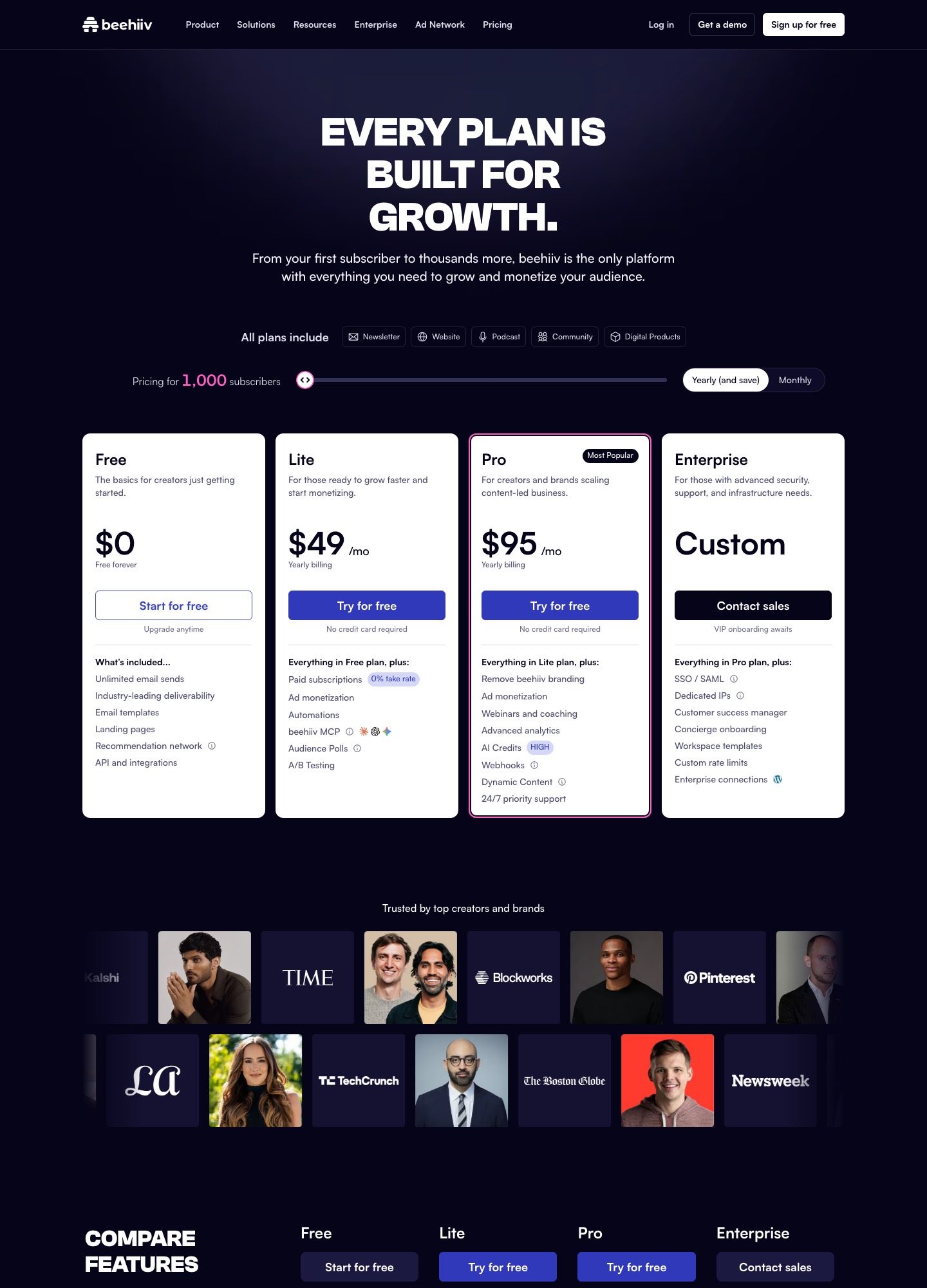
The free plan ends at 2,500 subscribers. beehiiv's pricing page offers Free for up to 2,500 subscribers with unlimited sends, 1 publication and 1 team seat. The 2,501st subscriber moves you to a paid tier, and the plans that list automations, paid subscriptions and audience polls begin at Lite. A newsletter that was costing nothing becomes a four-figure yearly line item on its way to 5,000.
The "$49" is a starting price, not a price for your list. The Lite card says $49 and the Pro card says $95, both with yearly billing, and the subscriber slider is where the real numbers show up. At 5,000 subscribers Lite reads $109 monthly or $95 yearly, and Pro reads $199 monthly or $169 yearly. At 10,000, Lite is $139 or $119 and Pro is $239 or $199. Pro at 10,000 on yearly billing is more than four times the $49 you saw first.
The monthly-billing penalty is large. Choosing monthly instead of yearly adds $14 a month for Lite at 5,000 subscribers, $20 at 10,000, and $40 at 10,000 for Pro. Over a year, that is $168, $240 and $480 respectively.
Seats are tight. Free has one seat, Lite has 2, and Pro has 10. A newsletter with an editor, a sponsor manager and a designer reaches the Pro plan for the seats alone.
The ad figure does not pay the plan. beehiiv's own cards quote an average ad income of $39 a month on Lite and Pro. If that average describes your newsletter, it does not cover the $95 yearly Lite price at 5,000 subscribers. The same page says beehiiv takes 0 percent of paid subscription revenue, with Stripe's 2.9 percent plus $0.30 per transaction still applying, which is a genuine reason to stay for paid newsletters and a weak one for free ones.
Quick comparison
| Alternative | Best if you | Billing unit | Price at 5,000 / 10,000 | Free plan |
|---|---|---|---|---|
| Kit | broadcast to a large free list | Subscribers | Free; Creator $75 / $116 | Up to 10,000 subscribers |
| Ghost | want your own site and members | Members | Business $199 for up to 10,000 members | None (managed hosting) |
| Substack | charge readers and avoid a monthly fee | Share of paid revenue | $0 / $0 plus 10 percent of subscription revenue | Free to publish |
| Buttondown | write in Markdown and add features piecemeal | Active subscribers plus add-ons | Add-ons +$9, +$29, +$79 | First 100 subscribers |
| MailerLite | want a lower monthly figure | Active subscribers | Comfort $49 / $89; Power $69 / $129 | 250 subscribers |
| Flodesk | design-led sends | Active subscribers | Lite $52 / $72 monthly | Forms and pages only, no sending |
| EmailOctopus | want a free list of 2,500 with a monthly send cap | Subscribers and emails | Pro $9 billed yearly at its 10,000 setting | 2,500 subscribers, 10,000 emails a month |
| Resend (Marketing) | write a developer newsletter | Contacts | Pro $40 / $80 | 1,000 contacts |
beehiiv itself reads $109 / $139 for Lite and $199 / $239 for Pro in the monthly view, and $95 / $119 and $169 / $199 on yearly billing. Kit's figures are with yearly billing; MailerLite, Flodesk and Resend are read in the monthly view.
Eight alternatives for people leaving beehiiv
1. Kit: a free list up to 10,000, then Creator
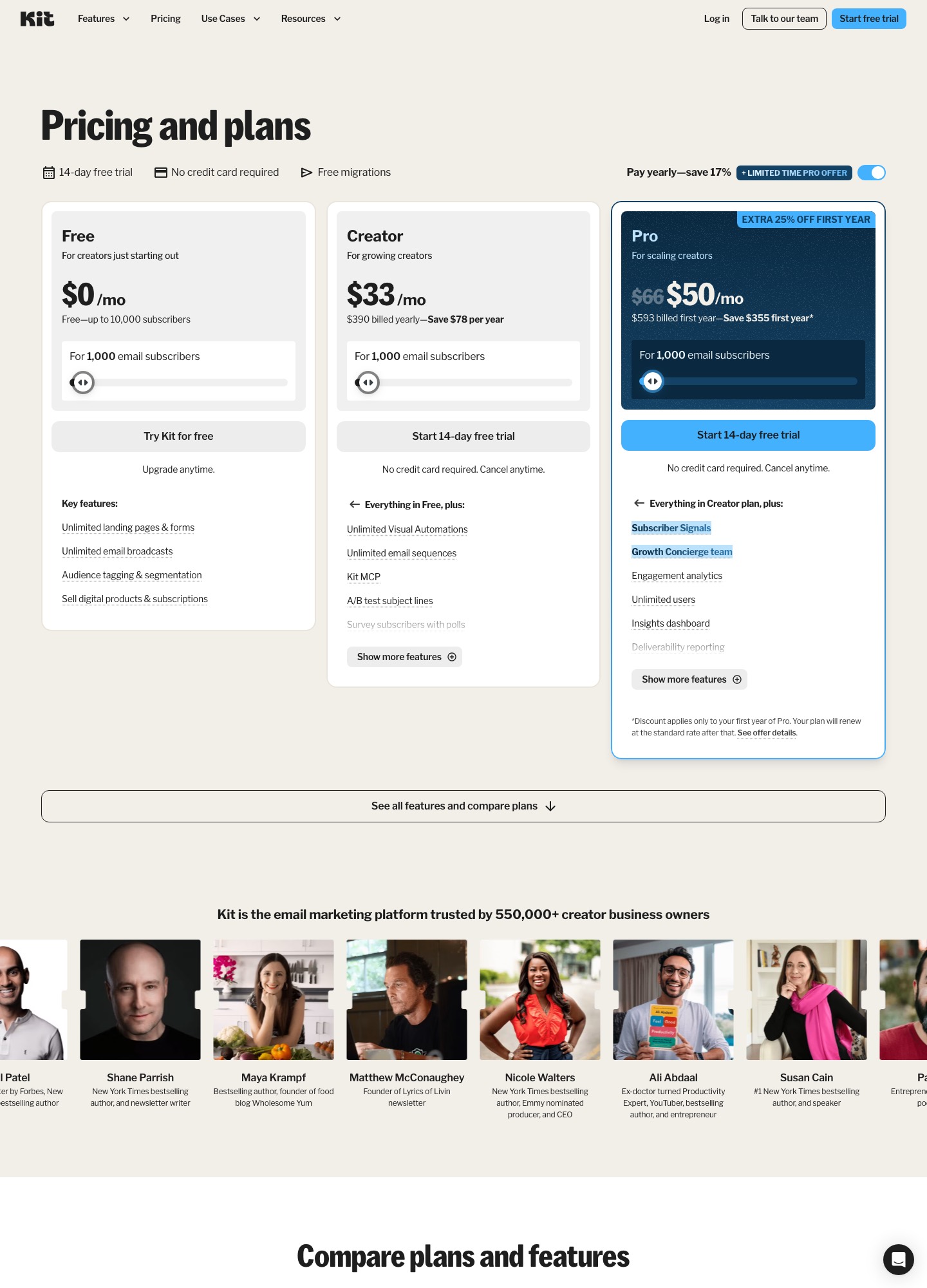
Switch if you mostly send issues and a few promotions to a list that has passed 2,500. Kit's free plan allows up to 10,000 subscribers, with unlimited landing pages, forms, broadcasts, tagging and segmentation, and it lets you sell digital products and subscriptions. At 5,000 subscribers that replaces beehiiv Lite's $95 yearly rate ($1,140 across twelve months) with nothing; at 10,000 it replaces $119 ($1,428). Visual Automations and sequences start on Creator, which is $75 at 5,000, $116 at 10,000 and $166 at 25,000. Against beehiiv Lite on yearly billing, Creator is $20 cheaper at 5,000 and $3 cheaper at 10,000, so the saving at the paid tier is small and the free plan is the real draw.
Kit Pro adds Subscriber Signals, unlimited users, deliverability reporting and a referral system, and is $158 at 10,000 subscribers against $199 for beehiiv Pro on yearly billing, with 10 seats. What you lose: beehiiv's pricing page markets a website, podcasts, a community and an ad network inside the subscription, while Kit's plan lists landing pages and forms. Kit offers free migrations and a 14-day trial. Buttondown vs Kit compares it with a lighter rival.
2. Ghost: your own site, members and no revenue cut
Switch if the publication is the product and the website matters as much as the email. Ghost's pricing page sells managed hosting, billed yearly: Starter is $15 a month for up to 1,000 members with 1 staff user, Publisher is $29 with 3 staff users, custom themes, paid subscriptions and analytics, and Business is $199 for up to 10,000 members with 15 staff users. Starter does not include paid subscriptions. There is no free plan; the open-source software is separate and self-hosted.
At 10,000 subscribers, Ghost Business at $199 equals beehiiv Pro's $199 on yearly billing and gives 15 staff seats instead of 10. At 5,000 you will find no matching stop on the page, so use its slider. Ghost fits a team that wants a custom theme and a members area. It does not fit a solo writer who is leaving beehiiv to spend less. If you are torn between owning the site and renting a platform, Ghost vs Substack lays out that choice.
3. Substack: no monthly fee, a cut of the revenue
Switch if you charge for the newsletter, or you send for free to a list that costs you $95 or more elsewhere. Substack's page says you can publish for free, and that if you turn on paid subscriptions it keeps 10 percent of subscription revenue and Stripe charges its own fees (2.9 percent plus $0.30 per US card payment, and 0.7 percent for Stripe Billing). A fully free newsletter at 5,000 or 10,000 subscribers costs $0 a month, against $95 to $139 for beehiiv Lite.
For a paid newsletter, the break-even sits where 10 percent of revenue equals the plan: $119 a month at 10,000 subscribers on yearly billing is reached at $1,190 of monthly paid revenue, $139 monthly billing at $1,390, and the $199 Pro price at $1,990. Below those numbers Substack costs less; above them beehiiv's zero percent take wins. There are catches: a custom domain costs a one-time $50 and emails still come from the substack.com sender address, and the export file does not hold subscriber names, which makes it a one-way door for your list. See beehiiv vs Substack for the full pairing.
4. Buttondown: pay for the features you use
Switch if you write in Markdown, keep the list small, and want to add features one by one. Buttondown's page says it costs nothing for the first 100 subscribers, then charges by active subscribers, and the base price includes a rich text or Markdown editor, a custom sending domain and hosted archives. Add-ons are priced separately: $9 a month for tagging and segmentation (the same group lists paid subscriptions, comments, surveys, analytics, RSS-to-email, sponsorships and attachments), $29 for automations, archives on a custom domain and multiple newsletters, and $79 for whitelabeling and teams.
The beehiiv Lite feature set of paid subscriptions plus automations maps to the $9 and $29 add-ons, so $38 a month on top of the subscriber charge. The page states the add-ons but the subscriber-based base fee depends on your list, so read it on the page for 5,000 or 10,000 subscribers before comparing. You lose beehiiv's ad network and its all-in-one website. Buttondown vs beehiiv has the direct comparison.
5. MailerLite: the straightforward price cut
Switch if you want to stay on a conventional email platform and halve the bill. MailerLite's pricing page lists Comfort at $49 for 5,000 subscribers and $89 for 10,000, and Power at $69 and $129. Comparing monthly view to monthly view, that is $60 less than beehiiv Lite at 5,000 ($109) and $50 less at 10,000 ($139), or $720 and $600 a year. Power, with unlimited monthly emails, is $130 below beehiiv Pro's $199 at 5,000 and $110 below $239 at 10,000.
The loss is the free tier: MailerLite's free plan stops at 250 subscribers with 2,500 monthly emails, compared with beehiiv's 2,500 subscribers and unlimited sends, so a list between 250 and 2,500 pays on MailerLite and not on beehiiv. It stores data in the European Union according to its page. Expect to replace beehiiv's ad network and publication website with your own sponsor deals and a separate site. MailerLite vs Mailchimp shows how it fares against the usual default.
6. Flodesk: well-designed sends at about half the price
Switch if layout and brand are why people read your newsletter. Flodesk's pricing page shows Lite at $52 monthly ($48 annual) for 5,000 subscribers and $72 monthly ($66 annual) for 10,000, with unlimited sends, 1 workflow and up to 25,000 subscribers. Pro, with unlimited workflows and 2 seats, is $59 and $79 monthly. Everything, which adds unlimited checkouts, sales pages, payment plans and subscriptions, is $107 and $137 monthly. The Free plan is forms, landing pages and a link-in-bio page, with no email sending.
Against beehiiv's monthly view, Flodesk Lite saves $57 at 5,000 subscribers and $67 at 10,000. Against yearly pricing on both sides, it saves $47 and $53. Everything is the plan to compare with beehiiv's paid-newsletter features: at $137 for 10,000 it is $102 a month below beehiiv Pro ($239 monthly). The one-workflow limit on Lite is the catch for a newsletter that wants onboarding sequences.
7. EmailOctopus: the same free list, with a send cap
Switch if you want the same 2,500-subscriber free list that beehiiv offers, from a different vendor. EmailOctopus Free allows 2,500 subscribers and 10,000 emails a month, adds EmailOctopus branding to your mail, keeps reports for 30 days and includes 1 landing page, 1 form and 1 user. Pro is $9 a month billed yearly at the 10,000 setting of its selector, with reports kept forever and unlimited landing pages, forms and users. Set the selector to your own list size and sending volume before you rely on that $9.
The send cap is the part to watch: a weekly newsletter to 2,500 subscribers is 10,000 emails a month in a four-week month, exactly the allowance, and a fifth send tips it over. beehiiv's free plan has no monthly send cap. The branding and 30-day reports also mean free EmailOctopus is a starter tool, not a permanent home for a growing publication.
8. Resend Marketing: for the newsletter written by a developer
Switch if you already send application mail through an API and want broadcasts in the same place. The Marketing tab on Resend's pricing page is free at 1,000 contacts with unlimited broadcast sending, 10,000 automation runs and 3 segments, then Pro is $40 at 5,000 contacts, $80 at 10,000, $180 at 25,000, $250 at 50,000 and $450 at 100,000, with unlimited segments. Against beehiiv's monthly figures that is $69 less at 5,000 and $59 less at 10,000.
What it does not list is a hosted publication, referral program or paid-subscription product, so a paid newsletter would need its own checkout. It suits a technical writer who wants a code-first workflow and a single vendor. For a refresher on the trade-offs between sending tools, the guide to choosing an email tool is the better starting point.
beehiiv's own pricing in short
Free is $0 up to 2,500 subscribers. Lite lists $49 and Pro $95 with yearly billing, up to 100,000 and 250,000 subscribers respectively, and the slider values for 5,000 and 10,000 subscribers are in the first table above. The capture below shows the page as read.
Switching from beehiiv
What leaves cleanly. The subscriber list, with each person's status and any custom fields, exports as a file. The posts are what readers and search engines know you by, so decide first whether the new home keeps the same URLs or needs redirects from the old ones.
What stays behind. Referral counts and rewards, poll results, ad network placements, automations and the website design are all beehiiv features that do not import elsewhere. Rebuild the welcome email by hand, and tell sponsors where your new sign-up form lives.
Paid subscribers. beehiiv's pricing page says it takes 0 percent of paid subscription revenue, and that you pay Stripe's standard processing fee of 2.9 percent plus $0.30 per transaction. The question is whether the new tool can take over the existing subscriptions or whether readers must resubscribe; read its migration documentation before announcing a date, and do not cancel the old plan until every paying reader is confirmed.
Consent and sending reputation. Export unsubscribed and bounced addresses along with the active list, and suppress them in the new tool before the first send. Authenticate your sending domain with SPF and DKIM. For a list over 5,000, send the first two issues to your most recently engaged readers, then widen. The bulk sending guide and the newsletter audience guide cover that ramp, and the email broadcast guide explains the sending basics.
Monthly cost for the shortlist
| Plan | 5,000 subscribers | 10,000 subscribers | Per year at 10,000 |
|---|---|---|---|
| beehiiv Lite (monthly / yearly) | $109 / $95 | $139 / $119 | $1,668 / $1,428 |
| beehiiv Pro (monthly / yearly) | $199 / $169 | $239 / $199 | $2,868 / $2,388 |
| Kit Free | $0 | $0 | $0 |
| Kit Creator | $75 | $116 | $1,392 |
| MailerLite Comfort | $49 | $89 | $1,068 |
| Flodesk Lite (monthly) | $52 | $72 | $864 |
| Resend Marketing Pro | $40 | $80 | $960 |
| Ghost Business (yearly billing) | Not listed at 5,000 | $199 for up to 10,000 members | $2,388 |
Yearly totals multiply the 10,000-subscriber monthly figure by 12 (for example $139 x 12 = $1,668). Substack and Buttondown are left out because they do not charge a flat plan at these sizes. For a similar read on a contact-based incumbent, see ActiveCampaign alternatives, or browse every alternatives page and the tools directory.
Choose by situation
- Pick Kit if you send to 2,500 to 10,000 subscribers and do not need sequences yet.
- Pick Substack if monthly paid revenue is under $1,190 (10 percent of which equals beehiiv Lite's $119 yearly price at 10,000 subscribers) and you want no fixed plan.
- Pick Ghost if you need a themed website, three or more staff users and your own members area.
- Pick MailerLite or Flodesk if the only complaint is the monthly figure.
- Stay on beehiiv if paid subscriptions, referrals and the ad network all earn money for you.
FAQ
How much does beehiiv cost at 5,000 and 10,000 subscribers?
On its subscriber slider, Lite is $109 a month at 5,000 subscribers and $139 at 10,000 in the monthly view, or $95 and $119 on yearly billing. Pro is $199 and $239 monthly, or $169 and $199 yearly.
Is there a free beehiiv alternative for a large list?
Kit's free plan covers up to 10,000 subscribers with unlimited broadcasts. Substack is free to publish and charges only when you turn on paid subscriptions. MailerLite and Buttondown stop being free at 250 and 100 subscribers.
Can I move paying subscribers away from beehiiv?
beehiiv's pricing page says it takes 0 percent of paid subscription revenue, minus Stripe's standard processing fee of 2.9 percent plus $0.30 per transaction. Whether the subscriptions transfer depends on the new tool, so confirm its import process before you announce a date.
What does Substack charge compared with beehiiv?
Substack charges nothing monthly and keeps 10 percent of paid subscription revenue, plus Stripe's fees. beehiiv charges a plan fee and no revenue share, so Substack is cheaper for a free or small paid newsletter and beehiiv for a large paid one.