Postmark alternatives: nine senders priced against its slider stops
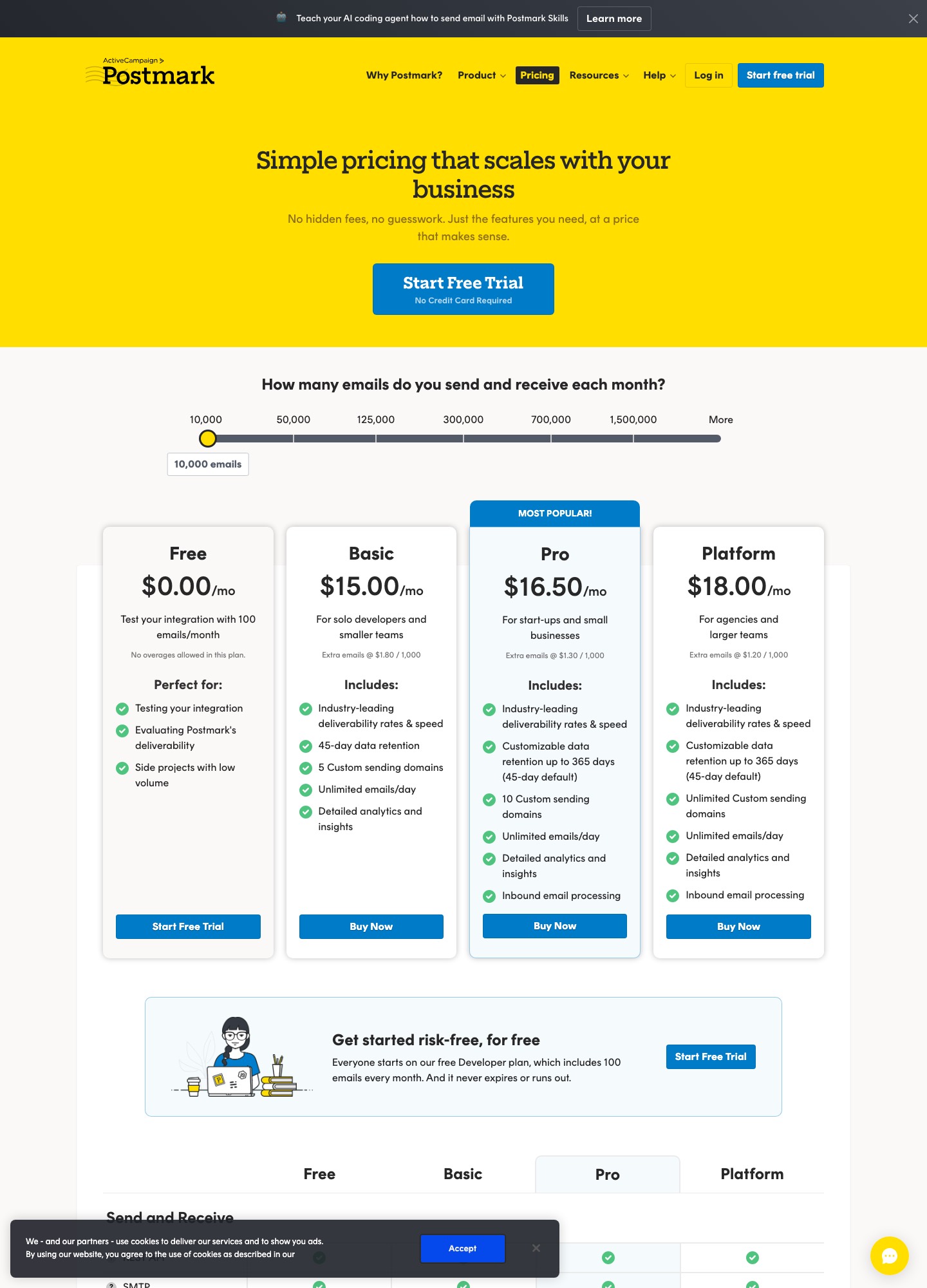
Postmark Basic costs $55 at 50,000 emails; Amazon SES, Resend, SendGrid, Mailgun and more list $8 to $35 for the same volume.
Short answer
People leave Postmark mostly over price at volume and over the way its plans gate things: the dedicated IP, the 365-day log window and inbound processing all sit behind higher plans or higher volume. My pick for a product team sending about 50,000 emails a month is Resend: its Pro plan is $20 at that volume against $55 for Postmark Basic, which saves $35 a month, or $420 a year, and Resend has a separate Marketing tab for broadcasts. If you have an engineer who will run the plumbing, Amazon SES is $8.00 at 50,000 emails. If you need a dedicated IP below 300,000 emails a month, SendGrid Pro includes one from $89.95. Every price was read on 7 October 2026.
Why people leave Postmark
Postmark's pricing page is built around a volume slider with fixed stops, and the stops are where the friction is. Basic, Pro and Platform cost $15, $16.50 and $18 at 10,000 emails, $55, $60.50 and $66 at 50,000, $115, $126.50 and $138 at 125,000, and $245, $269.50 and $294 at 300,000. There is no stop at 100,000. A team at 100,000 emails a month is between $55 and $115 on Basic, and you will not find the number on the page without asking. Going from the 50,000 stop to the 125,000 stop adds $60 on Basic for 75,000 more emails, so the step between those two stops only works out at $0.80 per 1,000 added emails; it is not a rate Postmark charges for emails in between.
Five more reasons come straight from the same page and its documentation.
- A 100-email free plan. The Free plan allows 100 emails a month and no overages. It is meant for testing an integration and judging deliverability, so a small product that sends a few hundred password resets pays $15 on the first day it outgrows it.
- Log retention by plan. Basic lists 45-day data retention. Pro and Platform list customisable retention up to 365 days with 45 as the default, and a custom activity retention add-on starts at $5 a month.
- Domains and inbound. Basic lists 5 custom sending domains, Pro lists 10 and Platform lists unlimited. Inbound email processing appears on Pro and Platform, not Basic.
- Dedicated IPs have a floor. The page says its managed dedicated IPs are for customers sending 300,000 emails a month or more, only on Pro or higher, from $50 a month per IP. DMARC monitoring is a separate add-on from $14 a month per domain.
- Webhook authentication. Postmark's webhook documentation says it does not support HMAC signature verification and recommends HTTP Basic Authentication together with allowlisting Postmark's IP ranges. A team that wants signed payloads has to look elsewhere.
Postmark also separates traffic into message streams, one for outbound transactional mail and one for broadcasts, inside a single account. That design is the reason many teams choose it, so check that whatever you move to can keep the two kinds of mail apart before you judge it on price alone.
Quick comparison
| Alternative | Best if you | Billing unit | Price at two volumes | Free plan |
|---|---|---|---|---|
| Amazon SES | have an engineer and want the lowest unit cost | Per 1,000 emails | $8.00 at 50,000; $20.00 at 125,000 | 6-month free plan, up to $200 credits |
| Resend | want a developer API plus broadcasts | Emails a month, or contacts | Pro $20 at 50,000; $35 at 100,000 | 3,000 a month, 100 a day |
| SendGrid Email API | need dedicated IPs under 300,000 a month | Emails a month | Essentials $19.95 at 50,000; Pro $249 at 300,000 | 100 a day for 60 days |
| Mailgun | want US or EU sending and inbound routes | Emails a month | Foundation $35 at 50,000; Scale $90 at 100,000 | 100 a day |
| MailerSend | want the lowest published monthly plan | Emails a month | Hobby $6.30 for 5,000; Starter $31.50 for 50,000 | 500 a month |
| Mailtrap | want the cheapest 100,000 step | Emails a month | Basic $20 at 50,000; $30 at 100,000 | 4,000 a month, 150 a day |
| SMTP2GO | send under 100,000 and want flat pricing | Emails a month | Starter $10 at 10,000; Professional $75 at 100,000 | 1,000 a month |
| SparkPost | need 30-day retention and cheap 50K | Emails a month | Startup $15 at 50K; Growth $175 at 250K | 1,000 a month, 50 a day |
| Brevo | also send newsletters from the same account | Emails a month | Starter $9, Standard $18, both from 5,000 emails | 300 a day |
Nine alternatives for Postmark leavers
1. Amazon SES: the lowest unit price, with the most assembly
Amazon SES's pricing page lists Essentials at $0.16 per 1,000 emails. Multiplying that out at Postmark's own stops gives 50 x $0.16 = $8.00 at 50,000 emails, 125 x $0.16 = $20.00 at 125,000 and 300 x $0.16 = $48.00 at 300,000, where Postmark Basic is $55, $115 and $245. The gap is $47, $95 and $197 a month, which over a year is $564, $1,140 and $2,364. AWS's own worked example for 250,000 outgoing emails on Essentials is $40.00. New AWS customers get a free plan for six months with up to $200 in credits, which covers a full parallel run.
The price has a cost in effort. SES lists SMTP and API sending, deliverability monitoring and Mail Manager inbound processing, but nothing on its pricing page matches Postmark's message streams or its 45-day activity retention, so you build stream separation, event handling and log storage yourself. SES also lists Pro at $0.22 per 1,000 with $105 per account per region per month and Enterprise at $0.23 with $500, and I did not read what those tiers add, so every number here is Essentials. A standard dedicated IP is $24.95 a month per IP, half Postmark's starting $50, and has no 300,000 gate on the pricing page. Choose SES when your volume is high enough that $8 versus $55 funds the engineering time.
2. Resend: the closest match for developers, at a lower price at 50,000
Resend's pricing page has a transactional tab with Free at 3,000 emails a month (100 a day, 3 domains), Pro at $20 for 50,000 emails and $35 for 100,000, and Scale at $90 for 100,000, $160 for 200,000, $350 for 500,000 and $650 for 1,000,000. At 50,000 emails that is $20 against Postmark Basic's $55, a $35 monthly gap. At 100,000 the Pro plan's $35 covers a volume Postmark has no stop for; its nearest higher stop is $115 at 125,000. Free is also a different offer: 3,000 emails a month is 30 times Postmark's 100.
For Postmark leavers who also send broadcasts, the Marketing tab matters. It is contact-based: free at 1,000 contacts with unlimited broadcast sending, 10,000 automation runs and 3 segments, then $40 at 5,000 contacts, $80 at 10,000 and $180 at 25,000. Scale adds a dedicated IP at $30 a month, available to customers exceeding 3,000 emails a day, which is a lower bar than Postmark's 300,000 a month. What you lose is retention: Resend's pricing page lists 30-day data retention on Free, Pro and Scale, against Postmark's 45-day default and its 365-day option on Pro and Platform. The page also does not describe webhook signing, so read Resend's webhook docs before you promise your security team anything. The Resend vs Postmark comparison goes deeper on that pair.
3. SendGrid Email API: dedicated IPs at 100,000, not 300,000
SendGrid's Email API pricing page lists Essentials from $19.95 for the 50,000 to 100,000 range ($34.95 at 100,000) and Pro from $89.95 at 100,000, $249 at 300,000, $499 at 700,000 and $799 at 1,500,000. At 50,000 emails Essentials is $35.05 under Postmark Basic's $55, and at 300,000 Pro's $249 is $4 above Basic's $245, so the price advantage only holds below about 300,000. Pro includes dedicated IPs, so a team that needs its own IP pays $89.95 at 100,000 rather than waiting for Postmark's 300,000-email gate and $50 a month per IP.
The free offer is a trial, not a plan: 100 emails a day for 60 days. Marketing Campaigns is a separate product with its own free plan of 2,000 contacts and 6,000 emails a month, then Basic from $15 and Advanced from $60, so broadcasts are not a stream inside the same plan as they are on Postmark. Choose it when the IP pool and the pricing at 100,000 matter most; the Postmark vs SendGrid comparison has the full side-by-side.
4. Mailgun: matching overage rates, shorter logs, EU sending
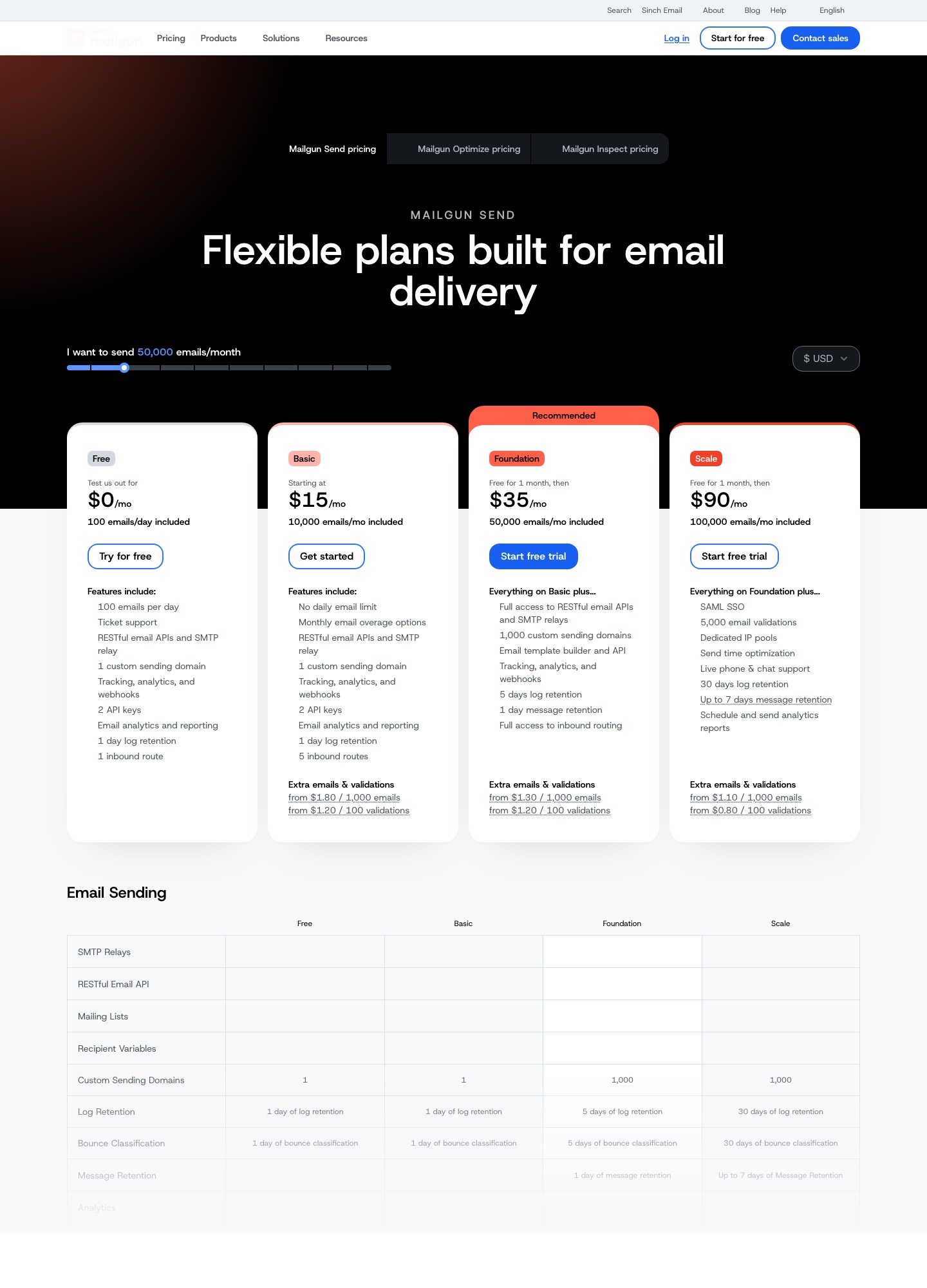
Mailgun's pricing page starts where Postmark does: Basic is $15 for 10,000 emails and charges extra emails from $1.80 per 1,000, the same figure as Postmark Basic's overage line. Foundation is $35 for 50,000 emails ($20 under Postmark Basic at that volume), $75 at 100,000 on its slider, and Scale is $90 at 100,000, $215 at 250,000 and $400 at 500,000. The free plan is 100 emails a day, which is 3,000 in a 30-day month, against Postmark's 100 a month.
Retention is where Mailgun gives something up. Log retention is 1 day on Basic and Free, 5 days on Foundation and 30 days on Scale, against Postmark's 45-day default on paid plans. In its favour, Mailgun's page says you can send through the US or the EU from a single account, and one dedicated IP is included with Foundation at 100,000 and with Scale, with additional IPs at $59 a month. Foundation also lists full access to inbound routing, which Postmark restricts to Pro and Platform. The SendGrid vs Mailgun page sets out how it differs from the other infrastructure choice.
5. MailerSend: the cheapest published monthly plan for small senders
MailerSend's pricing page has a free plan of 500 emails a month, Hobby at $6.30 a month for 5,000 emails ($75.60 billed yearly), Starter at $31.50 for 50,000 ($378 billed yearly) and Professional at $99 for 50,000 ($1,188 billed yearly, with 150 SMS a month). The monthly figures are the yearly-billing display. At 50,000 emails, Starter's $378 a year compares with $660 for Postmark Basic ($55 x 12), which is $282 a year less. Its FAQ gives a Starter example of $68 for 100,000 emails, and overage on Starter is $1.30 per 1,000.
The step that stands out for small senders is Hobby: $6.30 for 5,000 emails is a paid tier below anything Postmark sells, since Postmark jumps from its free 100 emails to $15 at 10,000. Professional is positioned for agencies and white-label resellers, with unlimited users and domains, so a Platform-plan agency on Postmark, where domains are unlimited at $18, has a direct equivalent. I did not read MailerSend's retention window or webhook signing on the page; confirm both before you migrate security-sensitive mail.
6. Mailtrap: published steps at 50,000 and 100,000 that undercut Postmark
Mailtrap's billing plans page lists a free plan of 4,000 emails a month with a 150 a day cap, Basic at $15 for 10,000 emails, $20 for 50,000 and $30 for 100,000, and Business at $85 for 100,000, $200 for 250,000 and $300 for 500,000. Postmark Basic is also $15 at 10,000, so the plans start level; by 50,000 Mailtrap Basic is $35 lower ($420 a year), and at the 100,000 step where Postmark has no stop Mailtrap Basic is $30.
Business is the plan to read carefully. $85 at 100,000 is $55 above Basic at the same volume, and I could not confirm from the page what the extra $55 buys, so do not assume dedicated IPs or longer retention. If you only need transactional sending at 50,000 to 100,000 emails with a free plan 40 times larger than Postmark's, Basic is the cheapest step I recorded.
7. SMTP2GO: flat steps for a sender under 100,000 emails
SMTP2GO's pricing page lists a free plan of up to 1,000 emails a month (200 a day), Starter at $10 a month for 10,000 emails ($100 a year) and Professional at $75 for 100,000 ($750 a year). Extra emails are $1 per 1,000 on Starter and $0.85 on Professional. Against Postmark Basic at 10,000, $15 x 12 = $180 a year, the yearly Starter price saves $80. At 100,000 emails Professional is $75 where Postmark has no stop and the next one, 125,000, is $115.
The page I read gives only these two paid steps, so a sender at 50,000 emails has no published SMTP2GO price on it and would sit between Starter plus overage and Professional; I would not guess which. It is a good fit for a small SaaS or an agency running several clients below 100,000 emails who wants a predictable bill and a free plan ten times Postmark's.
8. SparkPost: 30-day retention and a cheap 50K step
SparkPost's pricing page lists Free at 1,000 emails a month with a 50 a day cap, Startup from $15 for 50K and $30 for 100K, and Growth at $80 for 100K, $175 for 250K, $295 for 500K and $530 for 1M. At 50K Startup is $40 under Postmark Basic's $55, or $480 a year. Retention is 30 days on every plan, shorter than Postmark's 45-day default, and a Growth-only dedicated IP is $24.95 a month each, up to 5.
One feature of its billing deserves a note before you pick it: the default overage ceiling is five times your plan, and sends pause at the ceiling unless you agree different terms. For a business where a transactional email is a receipt or a password reset, a pause is worse than an invoice, so ask for different terms in writing before you rely on it. It is a reasonable alternative for a 50K to 250K sender that wants an IP add-on below Postmark's gate.
9. Brevo: when the same account has to send newsletters
Postmark leavers who also send promotional email sometimes consolidate onto Brevo, which lists Starter at $9 and Standard at $18, both starting at 5,000 emails a month, with a free plan of 300 emails a day. Brevo lists transactional email, SMS and WhatsApp campaigns, and automation and A/B testing on Standard, so one login covers what Postmark splits into streams. The first Starter step is 5,000 emails at $9, where Postmark's first paid step is 10,000 at $15.
I did not record Brevo at 50,000 emails, so I cannot put a price against Postmark's $55, and Professional starts at $499 for 150,000 or more emails, which is above Postmark Basic's $245 at 300,000. Choose Brevo for the consolidated tool, not for the lowest cost per transactional email. The Brevo alternatives page and the transactional vs marketing email guide explain why mixing the two on one reputation needs care.
Postmark's own price, summarised
Postmark charges per email volume from the slider: $15 (Basic), $16.50 (Pro) and $18 (Platform) at 10,000 emails, and the larger stops above. Basic carries the 45-day retention and 5 domains; Pro and Platform add 365-day retention and inbound processing. The $55 at 50,000 is what the alternatives are being measured against, and it is the number to challenge only if your volume sits near a stop. If you send under 10,000 emails a month, the $15 Basic step is within a few dollars of the cheapest alternatives here, so the migration work is rarely worth the saving. See email tools for transactional sending for the broader selection.
Cost at three volumes
| Tool and plan | 50,000 emails | 100,000 emails | 250,000 to 300,000 emails |
|---|---|---|---|
| Postmark Basic | $55 | Not a slider stop | $245 at 300,000 |
| Amazon SES Essentials | $8.00 (50 x $0.16) | $16.00 (100 x $0.16) | $40.00 at 250,000; $48.00 at 300,000 |
| Resend | Pro $20 | Pro $35; Scale $90 | Scale $160 at 200,000; 300,000 not recorded |
| SendGrid | Essentials $19.95 | Essentials $34.95; Pro $89.95 | Pro $249 at 300,000 |
| Mailgun | Foundation $35 | Foundation $75; Scale $90 | Scale $215 at 250,000 |
| MailerSend | Starter $31.50 | Starter $68 (FAQ example) | Not recorded |
| Mailtrap | Basic $20 | Basic $30; Business $85 | Business $200 at 250,000 |
| SparkPost | Startup $15 | Startup $30; Growth $80 | Growth $175 at 250,000 |
All figures are plan or slider readouts from each vendor's pricing page on 7 October 2026. The SES rows are multiplication of the listed Essentials rate by thousands of emails and exclude taxes, attachment data and add-ons. MailerSend figures are the yearly-billing display.
Switching from Postmark
Start with the DNS, because mail authentication is the part that can quietly break. Add the new provider's DKIM and return-path records to a subdomain you can send from in parallel, and leave Postmark's records in place until the last message has gone out through the old path. Move traffic in slices, for example a tenth of password-reset mail first, then receipts, then everything, and read bounce and complaint rates between steps. The deliverability guide covers what to watch while a new sending domain warms up.
What does not move is anything stored in Postmark: any templates kept there must be recreated in the new tool or in your own code, and message streams are a Postmark concept, so decide how outbound and broadcast mail will be separated, with subdomains, API keys or separate projects. Export your suppression list, hard bounces, spam complaints and manual suppressions, before cutover and load it into the new account first, because a new provider starts with no memory of who bounced. Postmark keeps activity for 45 days by default, so export the logs you need for audits while the old account is still open.
Webhooks are the part developers underestimate. Your handler currently trusts Postmark through Basic Auth and an allowlist of Postmark's IP ranges, if you followed its recommendation. Each new provider has its own payload shape and its own authentication scheme, so the handler is rewritten, not reconfigured. Test bounce, complaint and delivery events with the new vendor's sandbox before routing real mail. Our tools directory and the alternatives hub list other options if none of these fits.
FAQ
Is there a Postmark price at 100,000 emails?
No. Postmark's slider has stops at 10,000, 50,000, 125,000 and 300,000, and 100,000 is not one of them. Basic is $55 at 50,000 and $115 at 125,000, so a team at 100,000 cannot read its own price off the page.
What is the cheapest Postmark alternative at 50,000 emails?
Amazon SES, at 50 x $0.16 = $8.00 on Essentials, is the lowest I could calculate. Among published monthly plans, SparkPost Startup is $15, SendGrid Essentials is $19.95, Resend Pro and Mailtrap Basic are $20, and Mailgun Foundation is $35.
Do the alternatives separate transactional and broadcast mail like Postmark?
Postmark does it with message streams in one account. The pricing pages I read for the alternatives do not describe an equivalent, except Resend, which has a separate Marketing tab, and SendGrid, which sells Marketing Campaigns as a separate product. On the others you separate the two with subdomains and keys.
Can I verify webhook payloads with a signature after leaving Postmark?
Postmark's documentation says it does not support HMAC signature verification and recommends Basic Authentication with IP allowlisting. Whether a given alternative signs its payloads is not something the pricing pages say, so read each vendor's webhook documentation before you choose one for that reason.