Buttondown alternatives for broadcast email: where to go after the first 100 subscribers
Buttondown is free for 100 subscribers, then add-ons at $9, $29 and $79. Eight alternatives for growing lists, with prices at 1,000 to 10,000 subscribers.
Short answer
Kit is the best first stop for most people leaving Buttondown. Its pricing page lists a Free plan for up to 10,000 subscribers with unlimited broadcasts, forms and landing pages and tagging and segmentation included, where Buttondown's free allowance ends at 100 subscribers and tagging and segmentation is a +$9 a month add-on. Step up to Kit's Creator plan ($33 a month at 1,000 subscribers) only when you want sequences or visual automations. If you would rather pay a fixed, published price from day one, MailerLite's Comfort plan is $19 a month at 1,000 subscribers. All prices below were read on 7 October 2026 and are in US dollars.
Why people leave Buttondown
The first reason is a number that the page does not print. Buttondown's pricing page opens with "Absolutely nothing for your first 100 subscribers" and then hands the rest of the answer to a slider. We did not read what the slider charges above 100 subscribers, so this page does not quote a per-subscriber price for Buttondown and you should move the slider to your own list size before comparing anything below. What the page does state is the billing unit: "We charge for active subscribers — you only pay for the people who are actively receiving your emails." That is a fair rule, but it makes the bill depend on how often you clean the list.
The second reason is the add-on structure. The page we read lists three groups of paid add-ons. The +$9 a month group covers tagging and segmentation, paid subscriptions, comments and surveys, analytics, RSS-to-email, sponsorships and email attachments. The +$29 group covers archives on a custom domain, multiple newsletters and automations. The +$79 group covers whitelabeling and teams. Switching on one item from each group costs $9 + $29 + $79, which is $117 a month, $1,404 a year, before any subscriber charge. Most writers need one or two of these, but a writer who wants a second newsletter, a segment of paying readers and an assistant with a login lands in two groups quickly.
Third, the pricing model is a free first 100 subscribers plus add-ons, not a ladder of named plans, so a budget built around fixed tiers needs to be redone as a sum of the add-ons you actually switch on. Finally, the free plan is small by newsletter standards: Kit allows 10,000 subscribers and beehiiv 2,500 before either asks for money, so a list that has just passed 100 is where Buttondown stops being free and the others still are.
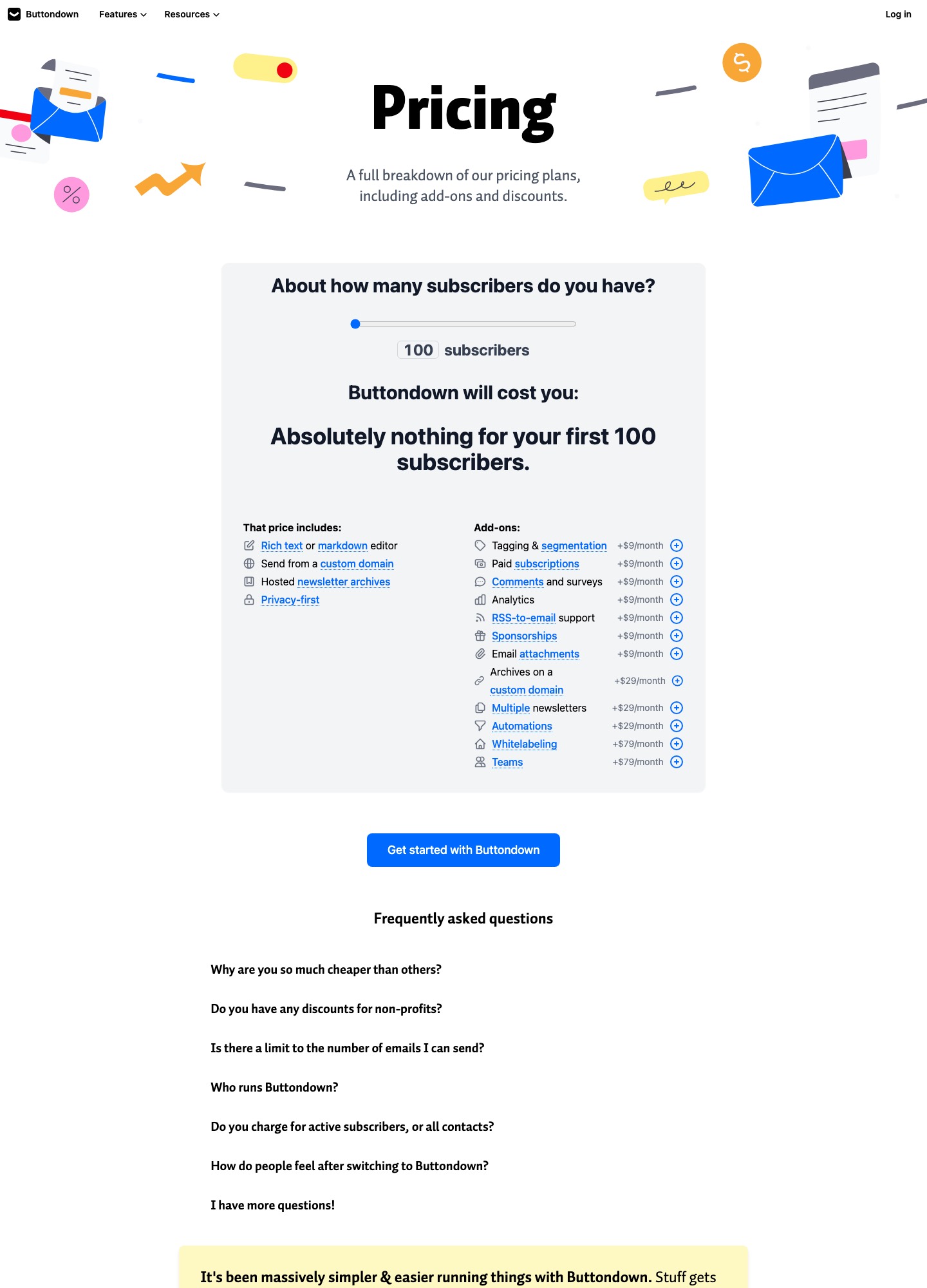
Stay put if your list is under 100 or if you value what the base price includes: the page lists a rich text or markdown editor, sending from a custom domain and hosted newsletter archives. Those three items are the ones to check on every alternative below, because several of them charge for or restrict one of the three.
Quick comparison
| Alternative | Best if you | Billing unit | Price at two list sizes | Free plan |
|---|---|---|---|---|
| Kit | want a large free list and sequences later | Email subscribers | Creator $33 at 1,000; $75 at 5,000 (billed yearly) | Up to 10,000 subscribers, broadcasts only |
| beehiiv | want growth tools and paid subscriptions | Subscribers (slider) | Lite $109 at 5,000 monthly; $139 at 10,000 monthly | Up to 2,500 subscribers, 1 publication |
| Ghost | want a website and newsletter in one | Members (audience size) | Starter $15 and Publisher $29 at 1,000 members; Business $199 up to 10,000 | None on the managed plans |
| Substack | want no fixed fee | Share of paid revenue | 10% of subscription revenue, plus card fees | Free to publish |
| MailerLite | want visual campaigns at a published price | Subscribers | Comfort $19 at 1,000; $49 at 5,000 (monthly billing) | 250 subscribers, 2,500 emails a month |
| EmailOctopus | send simple broadcasts to a larger list | Subscribers | Pro $9 a month, billed yearly, at the 10,000 setting | 2,500 subscribers, 10,000 emails a month |
| Resend | send from code and keep one vendor | Contacts | Pro $40 at 5,000; $80 at 10,000 | 1,000 contacts, unlimited broadcasts |
| Amazon SES | build the newsletter front end yourself | Per 1,000 emails | $0.16 per 1,000 emails on Essentials | Free plan for 6 months for new AWS customers |
The eight alternatives
1. Kit (formerly ConvertKit): the broadest free list
Kit renamed itself from ConvertKit, and kit.com/pricing is the current page. It suits the writer who has just crossed 100 subscribers and wants to stay at $0 for a while. Kit's Free plan runs to 10,000 subscribers and includes unlimited landing pages, forms and email broadcasts plus audience tagging and segmentation, which is the +$9 add-on at Buttondown. What you give up is the automation layer: Visual Automations and sequences start on Creator, quoted at $33 a month at 1,000 subscribers ($390 billed yearly), $75 at 5,000, $116 at 10,000 and $166 at 25,000. Buttondown's equivalent is the +$29 Automations add-on, but that sits on top of a subscriber charge we could not read, so the honest comparison starts above 1,000 subscribers.
Kit Pro is the answer to Buttondown's +$79 group: it adds Subscriber Signals, unlimited users, deliverability reporting and a newsletter referral system, at $158 a month for 10,000 subscribers and $233 at 25,000. Kit branding removal is listed from Creator upward, so free-plan senders should check how that looks to readers. Migration is the easy part: the pricing page advertises free migrations and a 14-day trial with no card, so export your Buttondown list and ask Kit to run the move. The detailed pairing is on our Buttondown vs Kit comparison.
2. beehiiv: growth and paid subscriptions in the plan
beehiiv fits the Buttondown writer whose problem is audience growth rather than editing comfort. Its Free plan covers up to 2,500 subscribers with unlimited email sends, one publication and one team seat. beehiiv lists its Lite plan at $49 a month on yearly billing, including paid subscriptions, automations and audience polls. The matching add-on groups elsewhere are +$9 and +$29, which together come to $38 a month before any subscriber charge. The slider is steeper than the headline: beehiiv Lite at 5,000 subscribers reads $109 monthly or $95 on yearly billing, and at 10,000 subscribers it reads $139 monthly or $119 yearly. Pro reads $169 yearly at 5,000 and $199 yearly at 10,000.
For paying readers beehiiv states that it takes 0% of subscription and digital product revenue, leaving only the standard card processing fee of 2.9% + $0.30 per transaction. On $2,000 a month of paid subscriptions, a 10% platform cut would be $200 a month. Hold that figure against the slider price. The loss is simplicity: Buttondown's single-editor workflow becomes a publishing platform with a web presence and team seats (2 on Lite, 10 on Pro). Read Buttondown vs beehiiv for the direct pairing and beehiiv vs Substack for the paid-newsletter angle.
3. Ghost: when the website matters as much as the email
Ghost suits the Buttondown user who has been bolting a website onto a newsletter. Ghost's pricing page lists managed hosting: Starter at $15 a month for up to 1,000 members with one staff user and no paid subscriptions, Publisher at $29 for the same audience with three staff users, custom themes, paid subscriptions and analytics, and Business at $199 for up to 10,000 members and 15 staff users, all billed yearly. There is no free plan on those tiers, although Ghost is also open-source software if you are prepared to host it yourself.
The comparison with Buttondown is the +$29 and +$9 add-on groups: Ghost Publisher at $29 already includes paid subscriptions and analytics, so a writer who would have bought those two add-ons stops stacking. The cost is the top of the ladder: Business at $199 for up to 10,000 members comes to $2,388 a year. We did not read the stops between 1,000 and 10,000 members, so a list of 3,000 should move the member slider rather than assume a mid-tier price. Migration means importing members and posts, then redirecting your old archive URLs to the new site.
4. Substack: no monthly bill, a cut of what you earn
Substack suits the writer who wants a fixed cost of zero and can accept a revenue share. Its page says writers keep 90% of their revenue minus credit card fees, so with paid subscriptions switched on Substack keeps 10% and Stripe charges its own fees (2.9% + $0.30 per payment for US cards, and 0.7% for Stripe Billing). Free publishing is allowed. From 1 December 2026 Substack says it will calculate, collect and remit sales tax or VAT on paid subscriptions at no extra cost, except in Brazil, Mexico, Malaysia, India and Thailand.
Against Buttondown the trade is plain. You lose the custom sending domain that Buttondown includes at the base price: a custom domain at Substack costs a one-time $50, and emails are still sent from a substack.com address. You also lose a clean exit, because the export has no subscriber names. Choose Substack only when your priority is a network audience and a zero fixed bill, and read Ghost vs Substack if you are torn between owning the site and renting the audience.
5. MailerLite: visual campaigns at published prices
MailerLite fits the Buttondown user who wants a drag-and-drop builder and a price list that does not hide behind a slider. The Free plan covers 250 subscribers, 2,500 emails a month and two user seats. Comfort is quoted at $19 a month at 1,000 subscribers, $49 at 5,000, $89 at 10,000 and $179 at 25,000, with a monthly allowance of 10 times the subscriber-tier ceiling. Power adds unlimited monthly emails at $39, $69, $129 and $239 on the same four steps. Annual billing brings the 500-subscriber starting price down from $12 to $10.80 on Comfort and from $25 to $22.50 on Power.
For a Buttondown writer at 1,000 subscribers, MailerLite's Power plan at $39 includes the automation that costs +$29 at Buttondown, so the two sit side by side once Buttondown's subscriber charge is read from its slider. MailerLite states that its data storage is in the European Union with an ISO 27001 certificate, which matters for some audiences. Expect to rebuild any markdown-based issues in a visual editor and to recreate each automation by hand.
6. EmailOctopus: a larger free allowance for simple broadcasts
EmailOctopus is the pick for a leaver whose list is big and whose needs are modest. Its pricing page lists a Free plan with 2,500 subscribers and 10,000 emails a month, but with EmailOctopus branding on emails, reports kept for 30 days, one landing page and form and one user. Pro reads $9 a month, billed yearly, at the 10,000 setting, and moves reports to forever and landing pages, forms and users to unlimited. The page shows 10,000 there without saying whether it counts subscribers or emails, and we read only that one stop, so do not assume the price at other list sizes.
Against Buttondown, the draw is the ceiling: 2,500 subscribers free versus 100. The lost items are the editorial ones: we did not read a Markdown editor, hosted archives or a paid-subscription feature on its page, and the 30-day report window on the free plan means you cannot compare this quarter with last. It is a sensible parking spot for a hobby newsletter with a list in the low thousands.
7. Resend: broadcasts for the writer who also writes code
Resend fits the developer-newsletter author who already sends app email through an API. Resend's pricing page has a Marketing tab priced by contacts: free at 1,000 contacts with unlimited broadcast sending, 10,000 automation runs and 3 segments, then Pro at $40 a month for 5,000 contacts and $80 for 10,000 contacts, rising to $180 at 25,000 contacts, $250 at 50,000 contacts and $450 at 100,000 contacts. Compared with Buttondown, the free plan is ten times larger and segments are included rather than priced as the +$9 add-on, though capped at 3 on free.
The loss is the publishing surface. We did not read a hosted archive or a paid-subscription feature for Resend's Marketing tab, which are two of the things Buttondown's add-ons sell, so you would pair it with a website for archives. Migration is a CSV import of contacts plus recreating each broadcast as an email template written in your own code or editor.
8. Amazon SES: the do-it-yourself floor
Amazon SES suits an engineer who wants to own every layer of a newsletter and pay as little as possible for sending. Its pricing page lists Essentials at $0.16 per 1,000 emails, and new AWS customers get a free plan for six months with up to $200 in credits. Four issues a month to 5,000 addresses is 20,000 emails, and 20 × $0.16 is $3.20 a month for sending.
That figure is only the sending. SES is infrastructure, not a newsletter product: it has no subscribe form, archive or editor, so you supply a list manager that you host yourself or write, plus suppression handling for bounces and complaints. Choose it when you would otherwise be paying Buttondown's add-ons for features you can build, and not when the point of leaving is to spend less time on tooling.
Cost at three list sizes
| Tool and plan | 1,000 subscribers | 5,000 subscribers | 10,000 subscribers |
|---|---|---|---|
| Kit Free (broadcasts, tags) | $0 | $0 | $0 |
| Kit Creator (billed yearly) | $33 | $75 | $116 |
| MailerLite Comfort (monthly) | $19 | $49 | $89 |
| MailerLite Power (monthly) | $39 | $69 | $129 |
| beehiiv Lite (monthly billing) | Free to 2,500 | $109 | $139 |
| Resend Marketing | $0 | $40 | $80 |
| EmailOctopus Pro (billed yearly) | Free to 2,500 | Not read | $9 at the 10,000 setting |
| Ghost (billed yearly) | $15 Starter, $29 Publisher | Not read | $199 Business |
| Buttondown | Slider not read; add-ons +$9 / +$29 / +$79 | Slider not read | Slider not read |
Billing bases differ: Kit, EmailOctopus, Ghost and the yearly beehiiv rates are annual-billing monthly equivalents, MailerLite and Resend are monthly figures. At 5,000 subscribers, beehiiv Lite on yearly billing reads $95. Substack and Amazon SES are left out because neither prices by list size.
Switching from Buttondown
Start with what leaves cleanly. Export your subscriber list from Buttondown, then check which columns arrive: you want the subscription date, any tag, the paid or free status and the source for each address, because those are your consent evidence and your segments. If a column is missing, save a separate export before you cancel. Unsubscribed and bounced addresses must come across as suppressed, not simply be left out of the file, or the new tool will happily mail them again the first time someone re-imports a list.
What does not move is the rest. Templates and automations are rebuilt by hand in the new editor. Archive pages live at Buttondown's addresses, so keep the old archive reachable or redirect it, particularly if you were paying for archives on a custom domain. Paid subscribers are the delicate case: they sit with a payment processor, not in a CSV, so confirm with the destination how existing Stripe subscriptions are carried before you promise readers an unchanged charge.
Run the pilot on the next two issues. Send issue one from the new tool to yourself, a colleague and about 50 of your most engaged readers, checking that the sender name, reply-to address and unsubscribe link behave. Publish issue two from the new tool to everyone while the old account stays open for a fortnight, then close it. The delivery lessons in our broadcast email guide and the list-building notes in building a newsletter audience help for the first week, and how to choose an email tool covers the decision if two of these tie. The full set of shortlists is on the alternatives hub and the tools directory.
FAQ
Is Buttondown free?
For the first 100 subscribers, yes: its pricing page says "Absolutely nothing for your first 100 subscribers", with the editor, a custom sending domain and hosted archives included. Above that the price comes from a slider that this page did not read, plus optional add-ons of +$9, +$29 and +$79 a month.
Which Buttondown alternative is cheapest for 5,000 subscribers?
Of the options with a published price at that size, Kit's Free plan costs $0 if you only send broadcasts, Resend's Marketing tab is $40 and MailerLite Comfort is $49 on monthly billing. Kit Creator is $75 and beehiiv Lite is $109 monthly or $95 on yearly billing.
What is the cheapest way to keep paid subscriptions?
With no fixed fee, Substack, which keeps 10% of subscription revenue plus Stripe's fees. With a fixed fee, beehiiv states a 0% take of subscription revenue beyond Stripe's 2.9% + $0.30, and Ghost's Publisher plan at $29 a month includes paid subscriptions for up to 1,000 members.
Do I lose my archive if I leave Buttondown?
You keep the content only if you export it before closing the account, and the page addresses will change. Keep the old archive live or redirect each URL to its new location, particularly if the archive was served on a custom domain through the +$29 add-on.